
In the current fast changing digital world, automation of workflow has become not only a luxury to businesses, but also a condition that may give a competitive advantage to the firms. Although n8n has become a popular open-source automation platform, more and more organizations are actively considering n8n alternatives, which may suitably meet their unique needs, technical abilities, and financial limitations.
By 2026, the automation marketplace will have a level of variety like never before, and each of the solutions will contribute something original to the table: a user-friendly interface and hi-tech AI development, or an enterprise-level security and a clear pricing scheme.
This in-depth overview of the top n8n alternatives will guide you in finding the right solution to simplify your business and discuss the possible constraints that you may find using n8n. Whether it is the cloud or self-hosted, we will discuss the specifics of each platform to help you make a wise decision that aligns with the automation process of your organization.
What Is n8n?
n8n is an open-source workflow automation platform that is a fair-code and integrates visual workflow building and vast code customization. It was released in 2019 and allows technical teams to develop advanced, AI-assisted automation workflows by interlinking more than 400 applications and services via a visual interface that is simple to use and node-based.
The distinguishing feature of n8n is that it has a platform capable of being self-hosted or cloud-hosted, between none-coded accessibility on the one hand and full code features on the other. This is because it allows developers and technically focused teams to tailor workflows to specifications and they have full control of their data infrastructure without having to worry about vendor lock-in.
Key Features
- Visual Workflow Builder: Drag-and-drop design tool of automation workflow.
- Vast Integrations: Integrate 400+ popular business apps, services, and APIs.
- Self-Hosting Version: complete control and privacy of data with ownership of infrastructure.
- Code Flexibility: Workflow support of custom JavaScript and Python code.
- AI-Native Platform: In-house LLM connectivity and AI agent workflow systems.
- Version Control: Versioning through git workflow and teamwork.
Why Look for Alternatives
- Steep Learning Curve: The presence of considerable technical expertise to the non-technical user and the beginning user.
- Developer-Centric: Higher features require knowledge of programming to be used to the fullest.
- Minimal Enterprise Support: Not as comprehensive as the commercial platform offerings.
- Fair-Code Licensing Restrictions: There are some commercial usage cases that are limited.
- Self-Hosting Overhead: The constant maintenance and infrastructure control needs of the platform.
- Smaller Integration Library: The number of pre-built connectors is lower than with the established competitors.
What Makes a Good Alternative to n8n?
- User-Friendly Interface: Intuitive design that is accessible to the non technical users with no knowledge of code.
- Comprehensive Integration Library: The most comprehensive library of ready-to-use connectors on a variety of platforms.
- Scalable Deployment Models: cloud, self-hosted or hybrid deployment support.
- State-of-the-art AI strength: Native AI agent support and fluent LLC.
- Enterprise Scalability: Architecture that can meet the increasing automation requirements.
- Transparent Pricing: Predictable transparent cost framework with no obscured charges.
Comparison Table: Top n8n Alternatives 2026
| Name | Best For |
| Zapier | Non-technical teams requiring quick automations with maximum app compatibility |
| Make (Integromat) | Visual automation enthusiasts needing powerful data transformation capabilities |
| Microsoft Power Automate | Large enterprises demanding governance, compliance, and robust security |
| Workato | Organizations requiring enterprise-grade integration with advanced security features |
| Pabbly Connect | Budget-conscious businesses needing unlimited workflows at affordable prices |
| ActivePieces | Open-source enthusiasts wanting AI agent capabilities with deployment flexibility |
| Tray.io | Mid-market teams managing API-heavy workflows with advanced debugging needs |
| Integrately | Beginners seeking one-click automation setups without technical complexity |
| Pipedream | Developers preferring code-first automation with generous free tier benefits |
| Node-RED | IoT and hardware integration projects requiring edge computing solutions |
Top 10 n8n Alternatives in 2026
1. Zapier
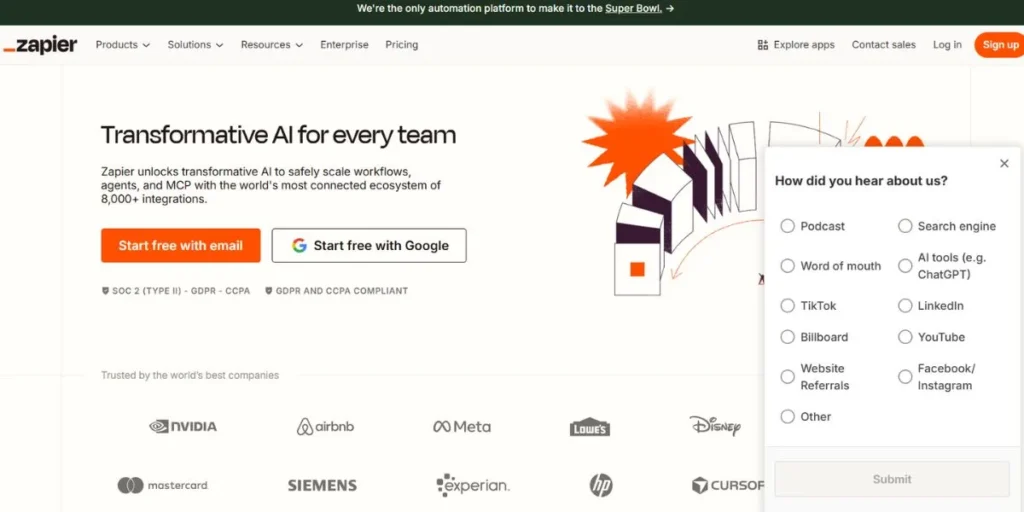
Zapier will continue to dominate the field of workflow automation due to unmatched simplicity in its offering with apparently the largest integration ecosystem in the industry by 2026. Having more than 8,000 app integrations, it allows users to create automated workflows with an incredibly user-friendly interface with no knowledge of zero code. The platform is outstanding in its ability to bridge cloud applications together, thus it should be the first option to be used by the business companies that are interested in automating tasks fast without having any technical background.
The recent release of AI-driven functionality by Zapier, such as Zapier Agents, which have the ability to reason and perform independently across connected applications is a major step in the advancement of no-code automation features.
Key Features:
- 8,000+ application integrations
- Multi-step workflow automation
- AI Agents functionality
- Built-in Tables and Interfaces
Best For: All business sizes seeking simplicity
Pricing: Free tier; paid from $19.99/month
Website: https://zapier.com
2. Make (formerly Integromat)
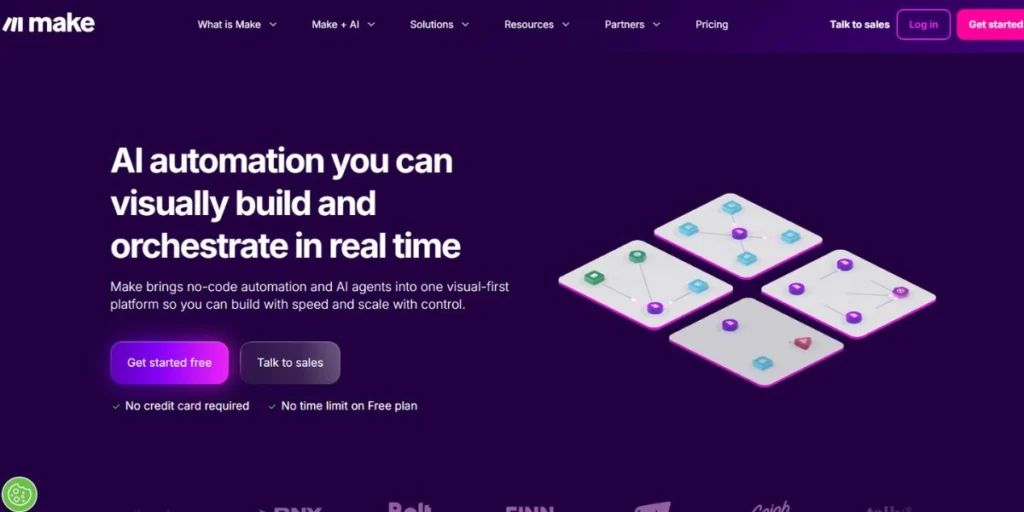
Make is among the strongest and least expensive n8n substitutes that are accessible to users that need complex automations and do not compose any code. It has a unique visual canvas, which shows work flows as interrelated modules, and offers crystal-clear visibility of the flow of data between applications. Make has a price model that is based on credit which in many cases is more cost effective as compared to other competitors, especially when it comes to multi-step workflows.
Having more than 1,500 integrations as well as sophisticated controls such as routers, iterators, and data transformers, Make provides finer-grained automation control at the cost of visual ease to users of all technical backgrounds.
Key Features:
- Visual scenario builder interface
- 1,500+ app connections available
- Complex data transformation tools
- Real-time workflow execution
Best For: Teams needing visual workflow power
Pricing: Free tier; Core from $9/month
Website: https://make.com
3. Microsoft Power Automate
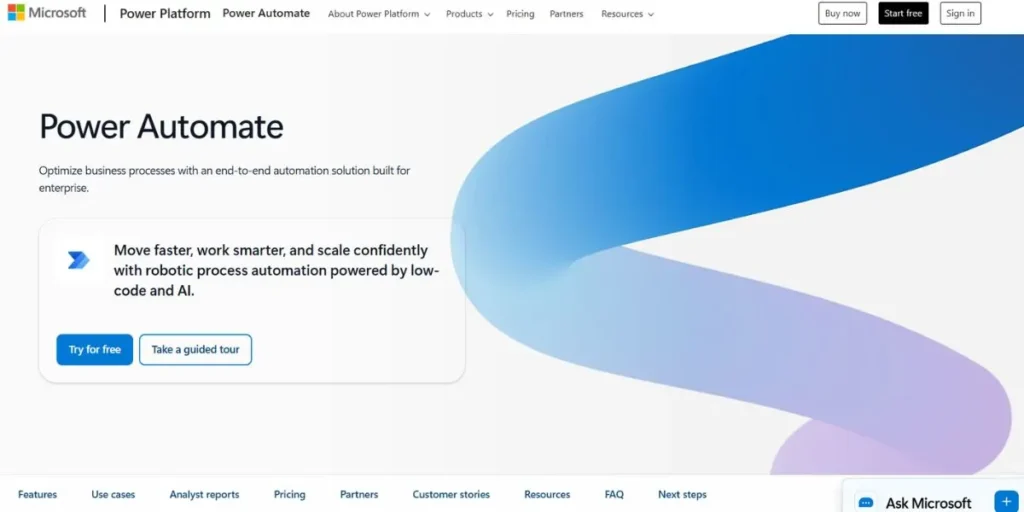
Microsoft Power Automate can be integrated into the Microsoft 365 platform, and therefore it is a perfect fit as an automation solution in the organization that already has invested in the number of Microsoft productivity tools. Its platform integrates both cloud flows and desktop flows, which include integrating apps and automating robotic process automation (RPA), respectively, which allows end-to-end automation of digital and legacy systems. The AI Builder feature of Power Automate allows processing of documents, analyzing sentiment, and writing predictive models, making it one of the strongest automation platforms that can be deployed in an enterprise. Its close coordination with SharePoint, Teams, Dynamics 365, and other Microsoft services develops strong synergies to Microsoft-focused businesses.
Key Features:
- Native Microsoft 365 integration
- Desktop RPA capabilities included
- AI Builder advanced functionality
- Process mining analytical tools
Best For: Microsoft 365 ecosystem organizations
Pricing: Premium at $15/user/month onward
Website: https://powerautomate.microsoft.com
4. Workato
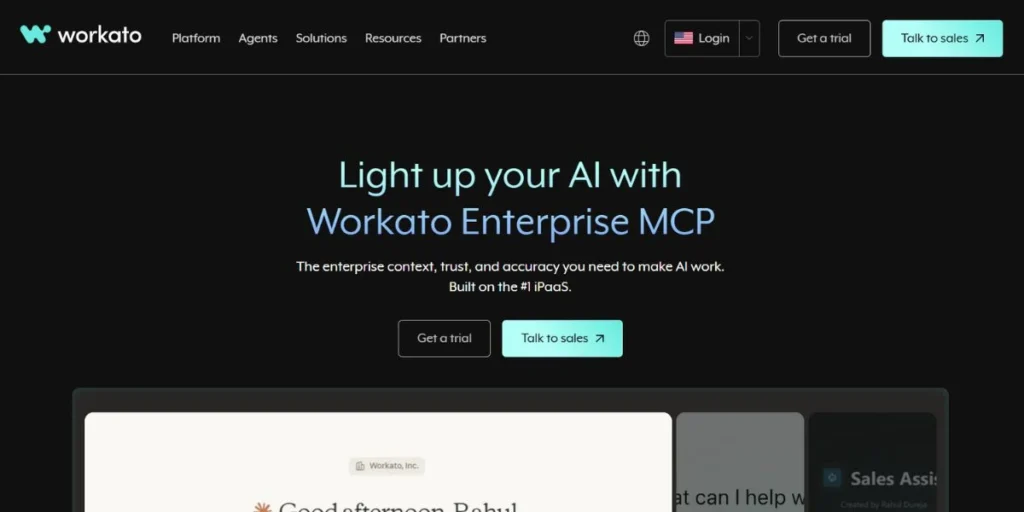
Workato poses as a business-scale automation platform that is deployed by businesses with high security, compliance, and governance needs. Being one of the most powerful n8n alternatives in large-scale implementations, it provides advanced recipe-based operations that mobilize complex business operations between different departments. The data handling capabilities of the platform are excellent with such features as SOC 2 compliance, HIPAA support, and role-based access controls.
The functionality of the Workato to connect enterprise resource planning (ERP) systems, customer relationship management (CRM) platforms and data warehouses with unprecedented reliability and security is especially appealing to the Fortune 500 companies.
Key Features:
- 1,000+ pre-built connector library
- Enterprise security and compliance
- Recipe-based workflow editor design
- Advanced governance and controls
Best For: Large enterprises requiring governance
Pricing: Custom enterprise pricing available
Website: https://workato.com
5. Pabbly Connect
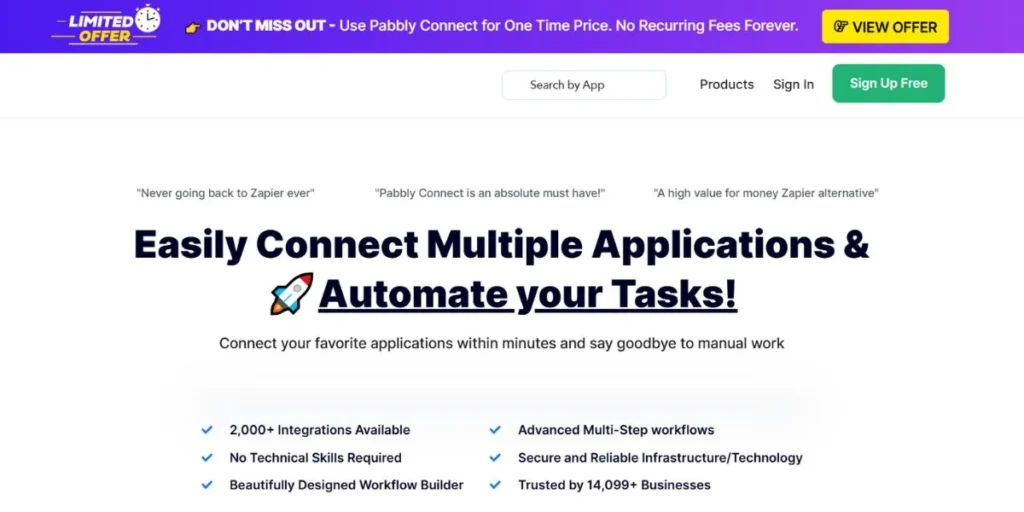
Pabbly connect stands out in the automation marketplace due to outstanding value proposal and different pricing that does not punish users who have an internal workflow step. In comparison to competitors, who have to pay per action, Pabbly uses only external actions as tasks, which means filters, routers, delays, and formatters can execute without using task limits. The platform has unlimited workflow on all the plans and comes with lifetime deals, which are highly demanded and only one-time payments are required.
Having more than 2,000 available integrations and powerful even in the free version, Pabbly Connect is a good choice among the small businesses and entrepreneurs who want to access a rich automation feature without feeling a subscription anxiety.
Key Features:
- Unlimited workflows on plans
- Internal steps don’t count
- 2,000+ app integration support
- Lifetime deal options available
Best For: Budget-conscious SMBs prioritizing value
Pricing: Free tier; Standard $14/month
Website: https://pabbly.com/connect
6. ActivePieces
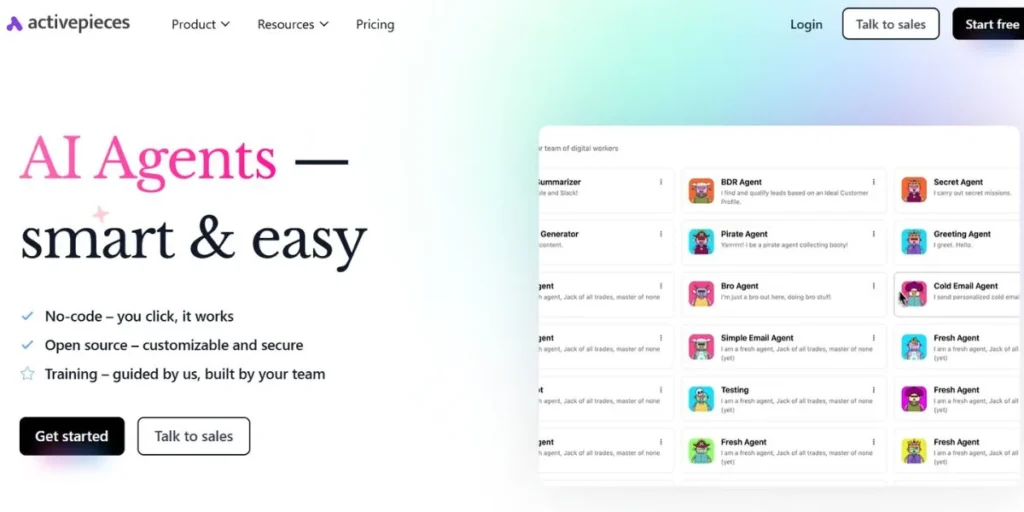
ActivePieces appears as an innovative open source platform of n8n alternatives, paying significant attention to AI agent functions and workflow automation. It is under the MIT license, and it is fully self-hosted with free workflow and extensiveness. The interface is based on the simplicity of Zapier and advanced artificial intelligence systems, which support simple automations and more advanced agent-based automations.
ActivePieces connects to more than 400 pieces and has dedicated features, such as Tables to manipulate data and human-in-the-loop approvals. Its two-tier product, including free cloud computing with task restrictions or unlimited self-computing, allows flexibility in deploying and scaling to many user requirements.
Key Features:
- Open-source MIT licensing model
- AI agent orchestration capabilities
- 400+ integration pieces library
- Complete self-hosting capability option
Best For: Open-source AI agent enthusiasts
Pricing: Free cloud; Pro $25/month
Website: https://activepieces.com
7. Tray.io
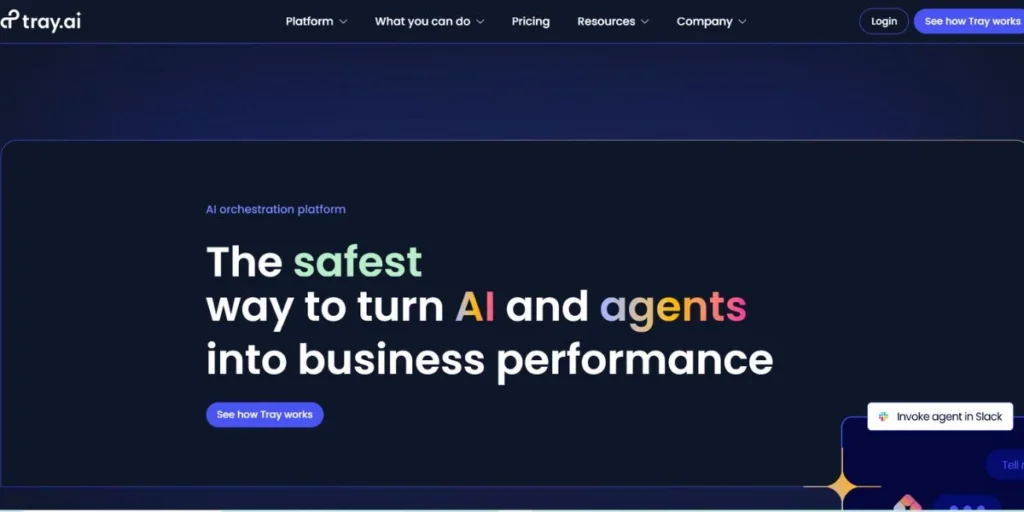
Tray.io is used by mid-market and enterprise businesses that need highly API-intensive processes with full debugging and monitoring functions. The Universal Automation Cloud offered by the platform is an integration platform as a service (iPaaS) platform integrated with low-code automation and AI augmentation. Tray.io can be really useful in scenarios where complex data transformation, conditional routing, and error handling are needed, providing highly scalable enterprise-level features to execute intricate business processes.
Tray.io has 600+ connectors and amazing scale, which enables it to handle mission-critical automations that need reliability and highly technical functionality in their automation setup.
Key Features:
- 600+ native connector ecosystem
- Advanced debugging tool suite
- Data transformation capabilities extensive
- Enterprise observability and monitoring
Best For: Mid-market API-heavy workflow teams
Pricing: Starting around $500/month estimated
Website: https://tray.io
8. Integrately
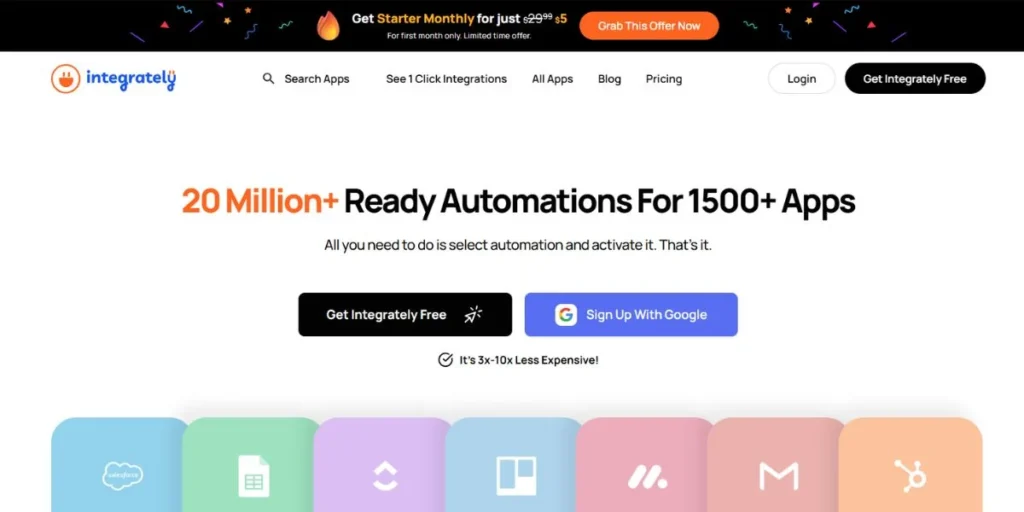
Combines the accessibility of automation by its exclusive one-click incorporation model to become a truly user-friendly platform among the top n8n substitutes to beginners. It also has more than 1,000 pre-built automations known as 1-Click Automations which can be enabled by any user without making any setup configuration. The interface of Integratively is also focused on speed and ease, allowing any non-technical person to connect applications and automate the workflow in a few minutes.
Although it is beginner-focused, it also allows multi-step automation, conditional logic, and webhook functionality to apply in more advanced requirements, which is an excellent balance between ease of use and capability.
Key Features:
- One-click automation setup system
- 1,000+ app integration library
- Simple transparent pricing structure
- Multi-step workflow automation support
Best For: Beginners wanting simple setup
Pricing: Free tier; Starter $19.99/month
Website: https://integrately.com
9. Pipedream
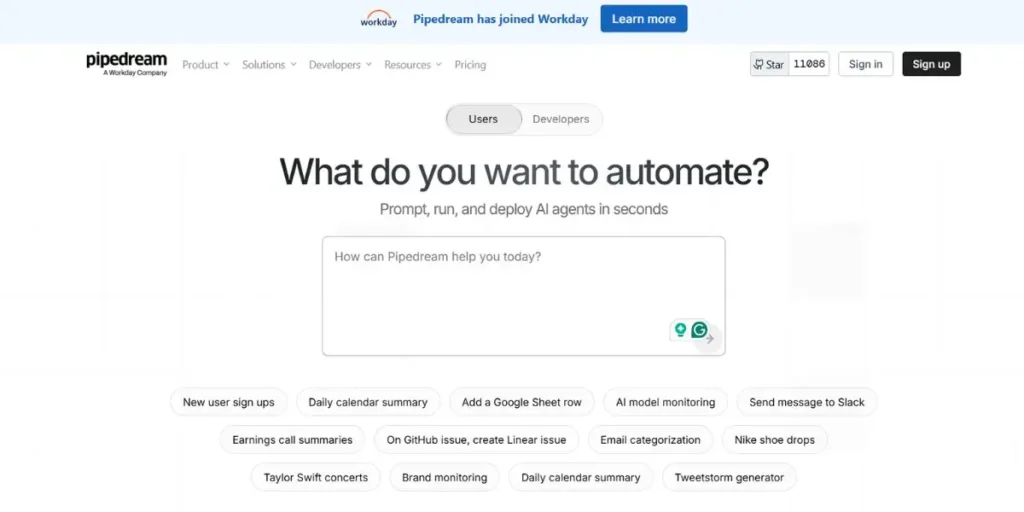
Pipedream aims at those who need to use code-first automation but still enjoy the comfort of the visual workflow. It is the only one to support no-code and support mixing with custom JavaScript or Python code, which offers high flexibility to technical users. The free version offered by Pipedream can be used by developers who develop side projects or startups with limited resources and have 1,000 free invocations and the ability to use all features.
The platform is superior in managing web hooks, API integrations, and event-based architecture with real-time execution and extensive logging options. This developer-friendly strategy makes Pipedream a significant option to n8n, when used by more technical teams.
Key Features:
- Code-first automation approach prioritized
- JavaScript and Python support
- Generous free tier offering
- Event-driven architecture foundation
Best For: Developers preferring code-first automation
Pricing: Free tier; Basic $29/month
Website: https://pipedream.com
10. Node-RED
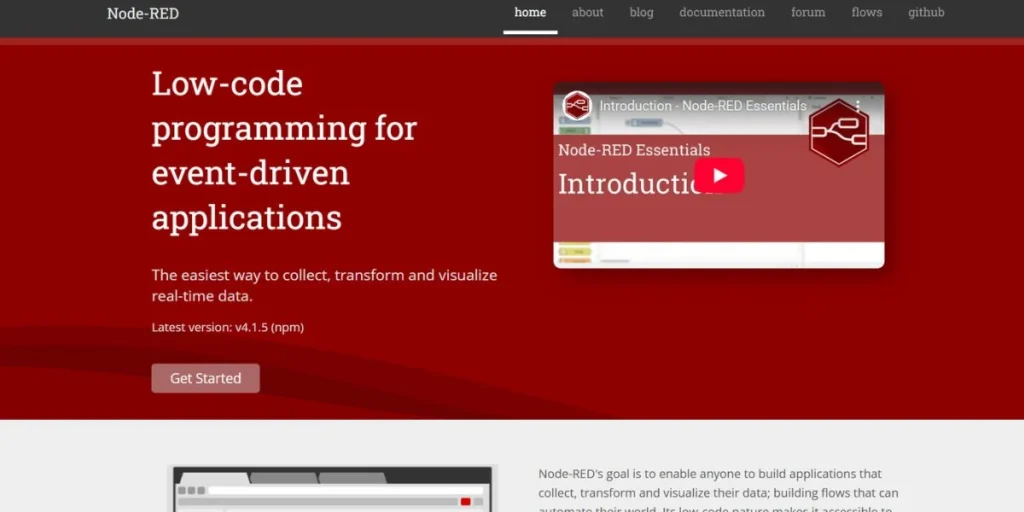
Node-RED is a unique type of flow-based programming platform tailored and created for the application in the Internet of Things (IoT) and hardware automation. This open-source has been built to operate on low-powered devices such as Raspberry Pi and thus ideal in edge computing and home automation. The visual editor of Node-RED allows users to connect nodes that represent devices, APIs, and online services as an easy-to-use drag-and-drop interface.
With a large community-driven node base and the ability to run on very small hardware, Node-RED has applications that are inaccessible to more traditional cloud-based n8n alternatives, especially in IoT and embedded systems.
Key Features:
- IoT-focused lightweight platform design
- Runs efficiently on Raspberry Pi
- Browser-based visual editor interface
- Extensive community node library
Best For: IoT hardware integration projects
Pricing: Free open-source Apache license
Website: https://nodered.org
Conclusion
Choosing the best workflow automation platform among these different n8n alternatives all depends on the needs of your organization, technical functions, and budgeting. Whereas n8n can be highly effective with teams that are technically-minded owing to its flexibility in an open-source manner and its code-friendliness, the alternatives discussed in this guide can be highly specific to their pain points and use cases. Zapier and Integrately focus on the accessibility of non-technical users, Make and Tray.io propose visual workflow richness, Microsoft Power Automate provides an easy integration with the enterprise ecosystem, and Workato offers better security to regulated fields.
Pabbly Connect will find a welcome in budget-conscious organizations, whereas these code-first developers will be attracted to the flexibility of Pipedream. With automation continuing to develop over the next five years, introducing more AI across, one of the n8n options that you will choose should take into consideration, the features such as the scope of integration, pricing policies, the ability to deploy applications, and the ability to expand in the long-term as your business needs expand and your automation needs increase.
FAQs
What is the cheapest n8n offering?
The cheapest deal is Pabbly Connect, which offers lifetime plans starting at 149 and includes unlimited workflows and ample task allowances, with no monthly fees.
What n8n alternatives is the least technical?
The specific focus of Zapier and Integrately for non-technical users is supported by easy-to-use drag-and-drop interfaces and prebuilt automation templates that do not require any coding knowledge.
Do there exist any self-hosted alternatives to data privacy?
Yes, there are several options that support self-hosting, such as ActivePieces (MIT-licensed), Node-RED (Apache-licensed), and enterprise plans from Make and Workato for organizations that need data sovereignty.
Which platform has the most app integrations?
Zapier has the most app integrations, with more than 8,000, and is the most comprehensive solution because it connects business applications across different systems and industries.
Are there any completely free plans in any n8n alternatives?
Various solutions are offering very high free limits: Zapier (100 tasks/month), Make (1,000 operations/month), Pabbly Connect (100 tasks/month), ActivePieces, Pipedream (1,000 invocations/day), and Node-RED (open-source, indefinitely).