
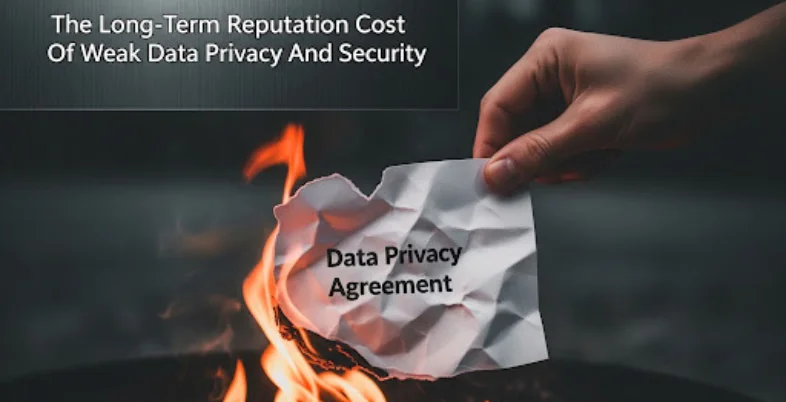
A data breach rarely ends when systems come back online.
The real damage begins afterward. Customers remember. Search results remember. Regulators remember. Years later, companies still answer for decisions made in moments when data privacy and security were treated as technical problems rather than as reputation risks.
Financial losses eventually stabilize. Reputation rarely does.
Weak privacy practices create consequences that compound over time, reshaping customer trust, brand perception, and competitive standing long after headlines fade.
Why Data Privacy And Security Are Reputation Issues First
Organizations often treat cybersecurity as an IT responsibility. Customers do not see it that way.
When personal data is exposed, people interpret the event as a failure of judgment. The breach signals carelessness, even when the cause was technical. Trust shifts immediately because privacy sits at the center of modern consumer expectations.
A breach tells customers three things:
- personal information was not protected
- warning signs were missed
- the organization reacted instead of prepared
That perception drives long-term reputation damage far more than the breach itself.
Companies working with NetReputation after security incidents often discover that online sentiment changes faster than internal teams expect. Negative coverage spreads across search results, review platforms, and social discussions within days, creating a lasting narrative that becomes difficult to reverse.
Financial Recovery Happens Faster Than Reputation Recovery

Direct breach costs are measurable. Reputation loss is not.
Insurance payouts, operational adjustments, and short-term revenue recovery often occur within two years. Market confidence, however, moves more slowly. Customers reconsider loyalty. Prospective buyers hesitate. Partners reassess risk.
The difference shows up in subtle ways:
- higher customer acquisition costs
- lower conversion rates
- increased skepticism during sales cycles
- prolonged negative search visibility
Stock prices may rebound quickly, but brand perception often lags for years. Once trust weakens, every future mistake is subject to harsher scrutiny.
Customer Trust Does Not Return Automatically
Customers rarely leave immediately after a breach. Many wait, watch, and quietly disengage later.
Trust erosion happens gradually. Users stop sharing data, reduce engagement, or move toward competitors perceived as safer. Loyalty programs weaken because participation depends on confidence in data handling.
Repeated breaches amplify this effect. Yahoo’s long-term reputation decline illustrates how cumulative privacy failures can permanently reshape public perception.
Rebuilding trust requires visible behavioral change, not statements alone. Clear privacy controls, transparent communication, and consistent accountability matter more than apology campaigns.
Organizations that fail to demonstrate change remain associated with risk long after technical fixes are complete.
Executives Increasingly View Privacy As Brand Protection
Leadership teams now recognize that privacy failures affect valuation, partnerships, and investor confidence.
Boards evaluate cybersecurity maturity as a governance issue, not an operational detail. Regulatory scrutiny reinforces this shift, turning privacy compliance into a visible signal of organizational credibility.
Incidents like the Capital One breach showed how configuration errors quickly evolve into investor concerns and regulatory investigations. The technical cause becomes secondary to public interpretation.
Strong data privacy and security practices communicate competence. Weak ones signal instability.
How Breaches Actually Happen
Most breaches do not involve sophisticated attacks. They exploit predictable weaknesses.
Common vulnerabilities include:
- phishing attacks targeting employees
- stolen credentials reused across systems
- misconfigured cloud storage
- outdated software left unpatched
- excessive internal access permissions
Human behavior remains the most consistent risk factor. Technology alone cannot compensate for unclear processes or a weak security culture.
Organizations that treat employee awareness as optional training often find that internal gaps lead to external crises.
Immediate Damage Versus Long-Term Harm
The first phase of a breach is visible and dramatic. Notifications, media coverage, and operational disruption dominate attention.
The second phase receives less focus but causes more serious damage.
Short-term effects include investigation costs, downtime, and regulatory response. Long-term effects reshape perception:
- sustained negative media indexing
- search results tied permanently to the incident
- declining brand preference
- increased sensitivity to future criticism
Trust behaves differently from revenue. It rebuilds slowly and declines quickly.
Regulatory And Legal Consequences Extend The Story
Legal outcomes ensure breaches remain visible long after resolution.
Regulatory fines, compliance audits, and class-action lawsuits keep incidents in public discussion for years. Each legal update renews media attention, reinforcing negative associations.
Privacy regulations now impose penalties significant enough to directly affect reputation. Enforcement signals to consumers that wrongdoing occurred, even when violations stemmed from oversight rather than intent.
Legal exposure, therefore, becomes a reputation amplifier rather than just a financial risk.
Competitive Advantage Quietly Shifts After Breaches
Competitors rarely need aggressive marketing after a breach. Customers move voluntarily toward brands perceived as safer.
Market share changes often appear modest at first but accumulate over time. Consumers’ choices of alternatives gradually reshape industry positioning.
Loss of trust also reduces pricing power. Brands associated with weak security often rely on discounts or incentives to maintain customer volume, weakening long-term profitability.
Strong privacy practices increasingly serve as a differentiator rather than a compliance requirement.
Recovery Is Slow And Often Incomplete
Reputation recovery follows no fixed timeline.
Some organizations regain stability within several years through transparency and sustained investment. Others never fully recover their previous standing because search visibility and public memory persist indefinitely.
Recovery depends on consistent signals:
- visible security improvements
- executive accountability
- transparent communication practices
- ongoing monitoring of online sentiment
NetReputation frequently works with companies long after incidents occur because digital narratives remain active even when internal teams believe recovery is complete.
Repairing reputation requires reshaping what appears in search results and reinforcing new trust signals over time.
Measuring Reputation Recovery Requires Patience
Progress rarely appears dramatic month-to-month. Instead, recovery shows through gradual improvement:
- customer sentiment trends stabilize
- negative search results lose dominance
- engagement rates improve
- retention begins to normalize
Organizations expecting rapid reputation repair often abandon efforts too early. Trust rebuilds through consistency, not speed.
Monitoring sentiment, search visibility, and customer behavior provides a clearer picture than financial metrics alone.
Strong Privacy Practices Prevent Long-Term Damage
The most effective reputation strategy is prevention.
Organizations that invest early in data privacy and security avoid the cascading effects that follow breaches. Preventive measures signal responsibility before problems occur and reduce the likelihood of public crises entirely.
Effective long-term protection includes:
- access controls aligned with least-privilege principles
- regular security audits and patch management
- employee awareness programs tied to real threats
- transparent data handling policies
- incident response plans tested before emergencies arise
Privacy resilience strengthens brand credibility even when incidents occur, as stakeholders recognize the preparation.
Weak security creates lasting stories. Strong security prevents them from forming.