
Application Programming Interfaces (APIs) in the connected digital world nowadays are the driving force of existing software development as they allow smooth interaction between various applications and services. With the growing use of APIs to drive the digital ecosystems of businesses, the determination of whether these interfaces can work properly, safely, and effectively has been a primary concern. This is whereby the choice of the most appropriate API testing tools is important to development teams globally.
The industry has a wide range of options for API testing services, with each service having its own set of testing needs, such as functional validation and performance benchmarking, security assessment and documentation. Regardless of being a one-person developer working on a hobby or a member of an enterprise team with a complicated microservice architecture, the selection of an appropriate testing tool may have far-reaching and potentially great influence on your development speed, the quality of the product, and, eventually, user happiness.
What is an API?
Application Programming Interface (API) is a collection of protocols, rules and tools used to allow other software applications to communicate and exchange data. Consider APIs as electronic intermediaries whereby one program can request services or information from another program without having to know how it works internally. APIs determine how and what developers can communicate with the outside software component, operating system, or microservice.
Practically, when you are using a mobile application to check the weather forecast, book a ride or make a payment, APIs are being used under the hood to access information on the servers, process your requests, and provide an answer. APIs are of several different types, such as REST, SOAP, GraphQL, and MQTT, each having different architectural frameworks and applications. APIs are essential in modern software development to create the modular, scalable applications in which various services might be developed, tested and deployed independently and yet remain integrated into a seamless system on a well-defined contractual basis with the API.
Essential Features to Look for in the Best API Testing Tools
It is crucial to take some of the features into account in order to choose the appropriate API testing solution, considering them with regard to the workflow of your team, as well as with regard to project-specific needs. The ultimate API testing tools must stream your test process as well as offer complete validation features in a variety of testing situations. The following are the key characteristics that qualify exemplary API testing tools above average:
- Protocol Support: There are a number of protocols that should be supported by A versatile API testing tool, including REST, SOAP, GraphQL, and MQTT, to remove the limitation of being restricted to one type of API within a given platform.
- Authentication Mechanisms: Find strong support for different types of authentication, including OAuth, API keys, JWT tokens, basic authentication, and bearer tokens.
- Environment Management: A well-controlled environment variable management enables one to easily change the environment to development, staging or production environment.
- Assertion Capabilities: Intense assertion capabilities allow full validation of API responses, such as status codes, headers, response times and verification of data structure.
- Ecosystem: Take into account what is known as an integration ecosystem, which means tools that can be seamlessly integrated with CI/CD pipelines, version control, and project management systems.
Read more: Best HR Companies in India
Top 10 Best API Testing Tools
1. Insomnia
Rating: 4.7/5
Website: https://insomnia.rest/
Best Use Cases: GraphQL testing, RESTful API development, environment variable management
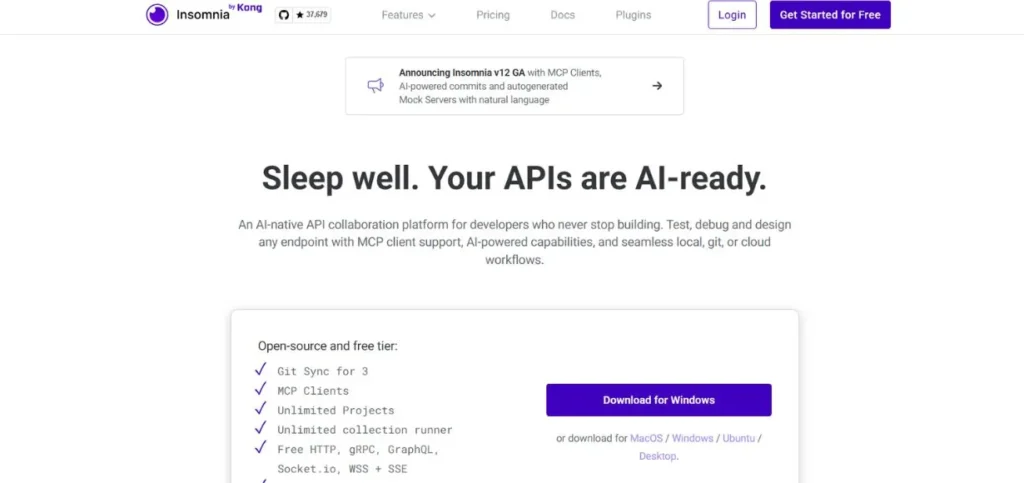
The most suitable API testing tool that developers choose when it comes to an elegant and modern interface with strong functionality is Insomnia. It is an open-source API client that is capable of performing both REST and GraphQL testing, with a simple yet sophisticated experience. It has a clean design, which minimises the cognitive load, and developers can design and test API requests instead of spending time navigating complicated menus.
A special mention should be made to the environment management system of the tool, which allows the teams to have distinct configurations of different deployment stages without complexities. The fact that insomnia has built-in support for various authentication schemes, such as OAuth 2.0, API keys, and JWT tokens, allows securing API endpoints easily.
Key Features:
- REST and GraphQL support
- Environment variable management
- Multiple authentication methods
- JSONPath response validation
- Clean, modern interface
Pros:
- Beautiful, intuitive UI
- Strong GraphQL capabilities
- Excellent environment handling
Cons:
- Limited collaboration features (free)
- No performance testing
- Less mature than alternatives
Pricing: Free
2. Karate DSL
Rating: 4.6/5
Website: https://karatelabs.github.io/karate/
Best Use Cases: Comprehensive test automation, CI/CD integration, multi-protocol testing
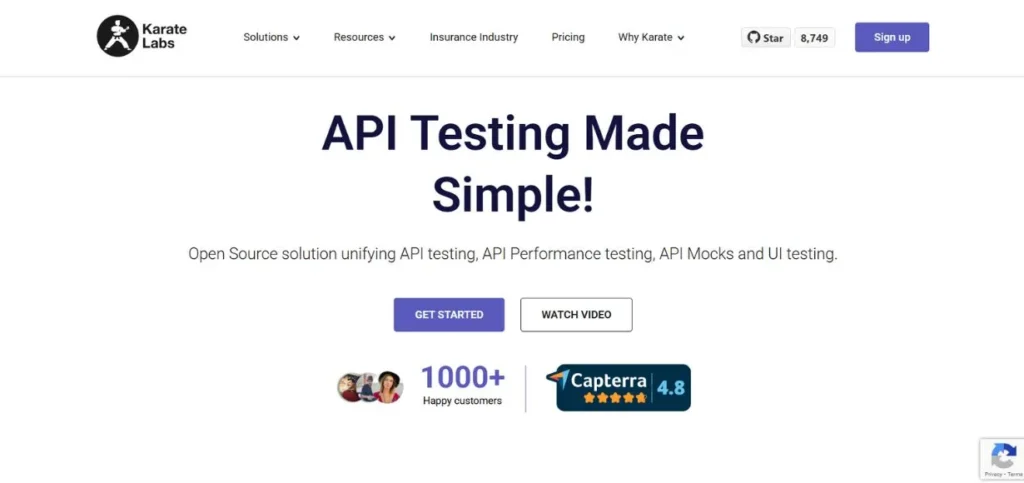
Karate DSL is the radically new approach to API testing that offers an all-encompassing framework that covers functional testing, performance testing, and even UI testing in the same ecosystem. It is an open-source framework used with a domain-specific language that is readable as natural language, thereby allowing test scripts to be used by teams, both technical and non-technical. The syntax removes both the boilerplate code and still gives the flexibility needed in complex testing situations.
What makes Karate one of the best API testing tools is the fact that it applies to testing of various types. Support for HTTP, JSON, GraphQL, and XML testing is built in, which is why it does not rely on external libraries. The framework is compatible with CI/CD pipelines and allows automatic testing during the development lifecycle.
Key Features:
- Multi-protocol API testing
- UI automation integration
- Data-driven testing support
- CI/CD pipeline compatibility
- No-code test definitions
Pros:
- Comprehensive testing approach
- Readable, declarative syntax
- Active community support
Cons:
- Java-based environment requirement
- Limited dedicated UI
- Scripting is needed for complexity
Pricing: Free
3. Rest-Assured
Rating: 4.8/5
Website: https://rest-assured.io/
Best Use Cases: Java project integration, automated REST testing, BDD-style testing
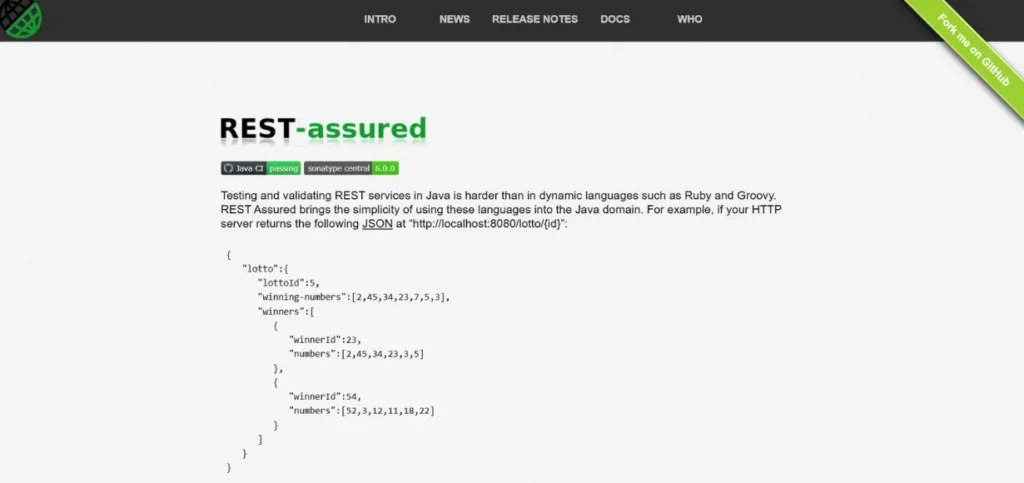
Rest-Assured has managed to become the choice of Java developers who need a dedicated library to test REST API. It is a potent framework that offers a domain-specific language that supports complex HTTP operations into readable, maintainable test code. The fluent interface of the library lets the developer intuitively chain methods to come up with test scripts that communicate their purpose in a way that is easily readable, yet speaks with technical accuracy.
Rest-Assured is one of the most appropriate API testing tools that organisations that have invested in the Java ecosystem should integrate with popular Java testing frameworks such as JUnit and TestNG. The framework manages authentication schemes with ease, it manages in-depth response parsing in both the case of JSON and XML formats and has strong assertion abilities.
Key Features:
- Java-based DSL
- JUnit/TestNG integration
- JSON/XML parsing
- Authentication support
- Query parameter handling
Pros:
- Highly readable code
- Seamless Java integration
- Strong community backing
Cons:
- Java-only limitation
- Requires framework knowledge
- No performance testing
Pricing: Free
4. Swagger UI
Rating: 4.5/5
Website: https://swagger.io/tools/swagger-ui/
Best Use Cases: API documentation, interactive testing, OpenAPI specification visualisation
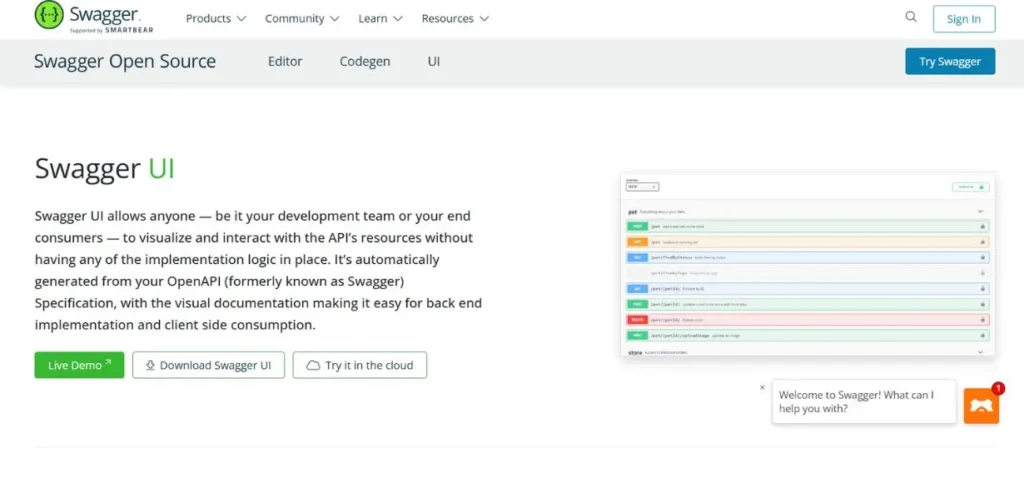
Swagger UI converts OpenAPI specifications into a living and interactive documentation, which can also be used to serve as an all-encompassing API reference and interactive API testing interface. This software will create web interfaces automatically and represent API endpoints, request parameters, response schemas, and authentication requirements. The resulting documentation remains aligned with API specifications, and the gap between documentation and implementation that afflicts most development teams is avoided.
Swagger UI is one of the most useful API testing tools for document-driven development since it gives stakeholders the ability to explore API functionality without writing any code. Developers are able to make actual requests to endpoints, inspect answers and test API conduct in real-time. The tool adheres to the standards of RESTful API in detail and can be easily integrated into development processes and CI/CD pipelines.
Key Features:
- OpenAPI specification support
- Auto-generated documentation
- Interactive browser testing
- Real-time endpoint exploration
- CI/CD integration support
Pros:
- Documentation and testing combined
- Time-saving automation
- Browser-based convenience
Cons:
- Limited advanced testing
- OpenAPI specification required
- Basic functionality only
Pricing: Free
5. JMeter
Rating: 4.4/5
Website: https://jmeter.apache.org/
Best Use Cases: Performance testing, load testing, multi-protocol testing scenarios
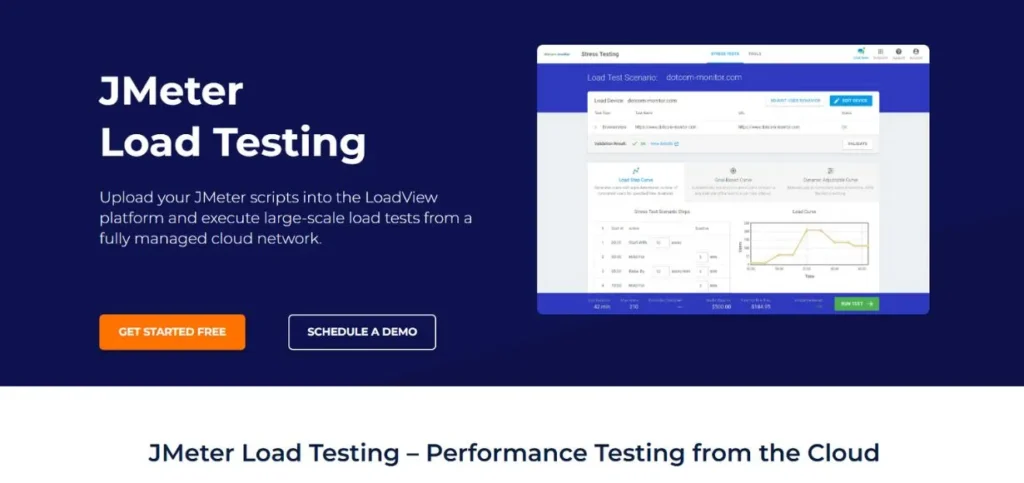
Apache JMeter has gained its reputation as a universal testing power that can test the functional correctness and performance features of APIs. Initially designed as a load testing tool to test web applications, JMeter has now been developed into a supported tool to support many protocols such as HTTP, HTTPS, SOAP, REST and FTP. The tool produces detailed performance metrics, response times, throughput rates, and the patterns of resource utilisation in different load conditions.
The reliability of the feature set and the ability of JMeter to be extended make it one of the most desirable API testing tools. Test plan creation is facilitated by the graphical interface, which allows creating test plans graphically, whereas complex situations are addressed with the scripting functionality in Groovy or BeanShell. Distributed testing capability enables the generation of load in multiple machines, as a simulation of realistic user loads. The large number of available plugins provides specialised features for the testing needs. Nevertheless, the interface complexity can be a problem because newcomers will have to overcome a learning curve.
Key Features:
- Several protocols can be supported easily.
- Test on distributed systems.
- Keep track of your performance measures in real time.
- Has a wide range of available plugins.
- Has the ability to write personal scripts.
Pros:
- Skilled in dealing with load testing situations.
- A very flexible fit to your needs.
- Backed up by the established Apache Foundation.
Cons:
- Needs a massive investment in learning.
- Performance-oriented, further complicated.
- The first configuration may be a difficult task.
Pricing: Free
6. SoapUI (Open Source Edition)
Rating: 4.6/5
Website: https://www.soapui.org/
Best Use Cases: SOAP service testing, WSDL-based testing, complex API scenarios
The wide range of features supported by SoapUI and the effective support of web service protocols have helped the product to remain the industry standard of SOAP and REST API testing. The open-source version offers great functionality to test the functionality, with a special strength in the testing of the services of WSDL. The interface of the tool can be accessed by testers with different technical backgrounds (point-and-click interface) and includes advanced features that can appeal to an experienced automation engineer.
The maturity of the tool makes it squarely among the most suitable API testing tools in the organisation that is involved in enterprise web services. In-built assertion functionality also allows verifying responses in more detail, and capabilities are further expanded by Groovy scripting support with complex testing cases.
Key Features:
- REST and SOAP support
- WSDL service handling
- Point-and-click testing
- Groovy scripting integration
- Advanced assertion capabilities
Pros:
- Mature, feature-rich platform
- Excellent SOAP support
- Large user community
Cons:
- Complex interface initially
- Performance issues possible
- Limited automation (free version)
Pricing: Free
Explore more: Best EdTech Companies in India
7. Mockoon
Rating: 4.7/5
Website: https://mockoon.com/
Best Use Cases: Local API mocking, frontend development, integration testing
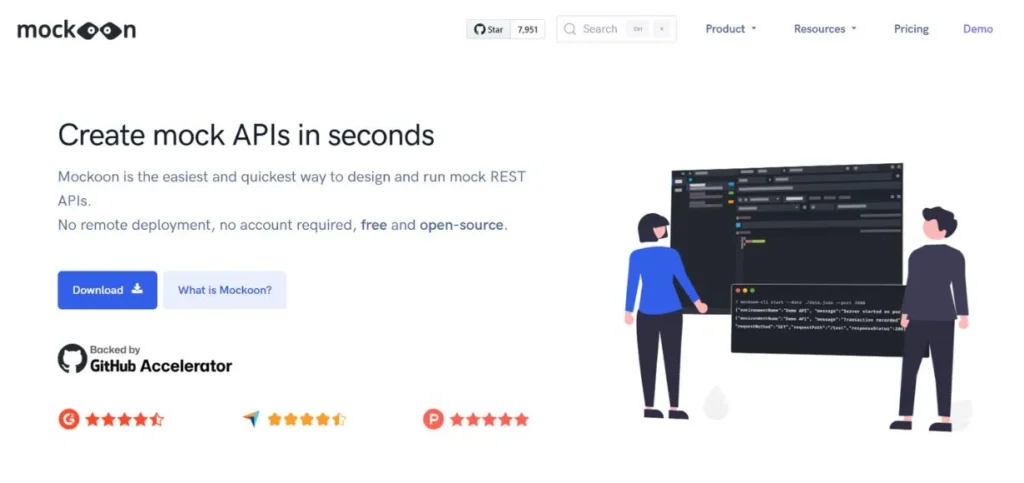
The process of creating mock REST APIs is made easy by Mockoon with a user-friendly interface that does not require any knowledge of zero coding knowledge. Local mock servers can be created within minutes, and they can be used to simulate responses of the APIs, despite the back-end services being under development or unavailable. This can be of great use to frontend developers who must develop on their own and to testers who want to have controlled conditions of responses.
The tool has a variety of environments, and it can be used to simulate various deployment configurations. Realistic testing can be done with dynamic response generation, custom HTTP status codes, configurable headers and response delay simulation.
Key Features:
- Code-free mock creation
- Multiple environment support
- Dynamic response logic
- Custom header configuration
- Cross-platform compatibility
Pros:
- Quick, easy setup
- Fully-featured free version
- Accessible to non-developers
Cons:
- Mocking only focuses
- No validation testing
- REST API limitation
Pricing: Free
8. Curl
Rating: 4.5/5
Website: https://curl.se/
Best Use Cases: Quick API requests, command-line testing, CI/CD script integration
Curl is the simplest style of testing an API by using its simple command-line interface to transfer data between protocols in the network. Curl has the ability of complex API testing scenarios, although it is simple because it has a strong scripting feature and great protocol support. The ubiquity of the tool in operating systems renders it universal in interacting with APIs among developers.
To developers familiar with terminal settings, Curl is one of the most suitable API testing tools to use in quickly validating requests and scripting automation. The utility has all the HTTP methods, such as GET and POST, PUT and DELETE, etc., and supports data manipulation with the help of custom headers, form data, and cookies.
Key Features:
- Multi-protocol support
- All HTTP methods
- Custom data manipulation
- Cross-platform availability
- Scripting capabilities
Pros:
- Lightweight and fast
- Powerful automation potential
- Command-line efficiency
Cons:
- No graphical interface
- Limited complex scenarios
- No test management
Pricing: Free
9. Pyresttest
Rating: 4.2/5
Website: https://github.com/svanoort/pyresttest
Best Use Cases: Python projects, REST API validation, performance benchmarking
Pyresttest provides a Python lightweight framework that provides REST API testing with a focus on declarative test descriptions. The tool is configured by using YAML or JSON configuration files and thus is less complex but provides flexibility in case of functional and performance testing. Pyresttest has a few dependencies and is easy to set up so that Python-focused development teams can use it.
In the context of the best API testing tools in Python environments, it is possible to mention Pyresttest, which provides such beneficial features as the possibility to generate mock responses, data schema-checking, and performance-testing. CI/CD integration makes it possible to provide automated API validation across development cycles.
Key Features:
- Configure your tests with YAML or JSON formats
- Includes automatic schema checking
- Track and assess performance data
- Generate simulated responses for testing
- Works seamlessly with your CI/CD systems
Pros:
- Operates as a lightweight Python solution
- Straightforward setup and configuration
- Flexible enough for various testing needs
Cons:
- Recent development progress has been slower
- No visual interface available
- Lacks some sophisticated functionalities
Pricing: Free
10. WireMock
Rating: 4.6/5
Website: https://wiremock.org/
Best Use Cases: HTTP service mocking, fault injection testing, dependency simulation
WireMock is an HTTP service mocking tool that has gone a step further and has features to give the API behaviour both during development and testing. The tool creates realistic API stubs simulating various response scenarios, and it can completely test systems based on an external API. Request proxying, dynamic stubbing and record-replay functionality give full control of the behaviour of the mocked services.
The fact that WireMock happens to be one of the best API testing tools can be attributed to the fact that it enables one to simulate the real-life conditions that would otherwise be difficult or even impossible to attain using the actual APIs.
Key Features:
- Dynamic HTTP stubbing
- Record and replay
- Network fault simulation
- Multi-format payload support
- Proxying capabilities
Pros:
- Excellent dependency simulation
- Fault injection support
- Strong enterprise adoption
Cons:
- Configuration complexity initially
- Mocking-focused scope
- HTTP protocol only
Pricing: Free
How to Choose the Best API Testing Tools
To choose among the great number of options, you have to systematically analyse them according to your needs and limitations. One organisation can not rely on the best API testing tools that one company can use because they differ in terms of technology stacks, team structure, and the purpose of testing. These are important considerations that you can make in your choice:
- Team Technical Expertise: Assess your team in areas of programming and familiarity with a tool prior to making a commitment to go with a solution. This is because command-line programs such as Curl or frameworks such as Rest-Assured are powerful and flexible, but focus on technical expertise.
- Testing Scope Requirements: Clarify your testing requirements of functional testing, performance testing, security testing or a more thorough testing that covers a variety of dimensions.
- Ecosystem Compatibility Integration: Reflect on your current development infrastructure, such as version control systems, CI/CD pipeline, project management platform, and monitoring tools, and compatibility with the testing tools.
- Budget and Licensing Constraints: Evaluate the overall cost of ownership, such as licensing costs, training costs, infrastructure costs and maintenance overhead.
- Scalability and Future Growth: Measure how your testing requirements will change as your applications grow and your teams grow. Select the tools that can scale with your organisation, instead of having to be replaced because the tools are too complex.
Conclusion
The world of API testing solutions is a diverse ecosystem where each of the tools has its advantages and disadvantages based on specific situations and staff setups. The most popular API testing tools have similar features: they are reliable, extendable, and supported by the community, and are better in some specific areas, like mocking, performance testing, or functional testing. With its beautiful interface and the Java support of Rest-Assured to the performance and realistic mocking power of JMeter and WireMock, the current developers have never had more choices on how to guarantee API quality.
You can focus on ease of use, the level of performance testing, the flexibility of protocols, or the cost, but you should be aware of the strengths and weaknesses of each tool to make a well-informed decision in the context of your own unique situation. The optimal API testing tools eventually enable teams to achieve reliable, performant APIs that fulfil the user expectations and the business goals. Since APIs will continue to transform digitally, the investment in proper testing infrastructure is more and more critical as a competitive advantage.
Frequently Asked Questions
Q. What is so good about a tool to make it one of the best API testing tools?
A: A combination of an all-inclusive protocol support, user-friendly interfaces, a powerful assertion engine, easy CI/CD integration, and solid community support has formed the best API testing tools. They must be able to align them with the technical knowledge of your team and offer the special testing needs of your projects, functional, performance, or security.
Q. Is it possible to use several API testing tools simultaneously?
A: Absolutely. Most of the winning teams integrate special tools to exploit their distinctiveness. An example of this is that, with Mockoon as a local development mocking tool, Rest-Assured as an automated testing tool, and JMeter as a performance evaluation tool, one gets holistic coverage in all testing dimensions that do not sacrifice depth in any dimension.
Q. Are open-source API testing tools reliable to be used in production?
A: Indeed, open source API testing software such as JMeter, Rest-Assured, and SoapUI is commonplace in enterprises all over the world. They have strong features, vibrant teams, and experience. Nonetheless, assess support needs and decide on the possibility of commercial support of your particular risk profile.
Q. Are there any requirements to use API testing tools?
A: It depends on the tool. Other graphical solutions, such as Insomnia, Mockoon and Swagger UI, need little to no knowledge of coding, whereas frameworks such as rest-assured and Karate DSL need prior knowledge of programming. Suchcommand-linee tools as Curl demand technical skills. Select tools that are appropriate in terms of the skill levels of your team and effectiveness.
Q. What do you think are the intervals for updating my API testing tools?
A: Update the monitor tool frequently, and patches for security vulnerabilities are implemented immediately. Significant version changes are to be considered in terms of new functionality, breakages and compatibility with your own test suites. Keeping fairly up-to-date versions is a compromise between being able to access improvements and having the stability needed in production testing environments.
Continue exploring: Best OTT App Development Companies