
Your website might look perfect on the surface—but do you know what’s hiding underneath? Every day, thousands of sites are hacked simply because of unnoticed security gaps. That’s where Website Vulnerability Scanners become your secret shield.
These powerful tools dig deep into your website, uncover hidden flaws, and alert you before attackers can strike. Whether you’re running a blog, business site, or full-scale online store, a good vulnerability scanner helps you stay one step ahead, protect user data, and maintain trust. If you want a safer, stronger, and attack-proof website, understanding these scanners is the perfect place to start.
In this blog, we’ll not only explain how these scanners work but also explore the top Website Vulnerability Scanners you can use to keep your site safe, fast, and secure.
What Is a Website Vulnerability Scanner?
A website vulnerability scanner is a computerised security device that acts as a virtual bodyguard of your website. It performs a scan on all of your pages, forms, plugins, APIs, and inner workings to identify weak defences against hackers, including SQL injections, cross-site scripting (XSS), broken authentication, improperly configured and/or misaligned security headers, and old software that they frequently exploit.
The scanner will not wait till an attack has occurred ,but instead, it puts a simulation of hacker attacks to see how your site responds and notifies you on the spot in case it detects the vulnerability. This will enable you to correct the problems before they are abused by cybercriminals.
These scanners are a vital part of the contemporary DevSecOps pipeline, in particular, in the context of CI/CD, where each new update is secure. They also facilitate ongoing security surveillance and assist companies to remain in line with such standards as PCI DSS, HIPAA, and ISO 27001. In simple terms, a web vulnerability scanner ensures the security of your website, consistency and preparedness to counter attacks in the real world.
How Website Vulnerability Scanners Work?
The operation of Website Vulnerability Scanners.
- Target Discovery and Enumeration: Using the scanner, your domain, subdomains, and available assets are identified so as to comprehend the entire attack surface of the site.
- Crawling & Fingerprinting: It scans all the pages to identify forms, inputs, technologies and CMS versions to assist in matching known vulnerabilities (CVEs).
- Payload Injection & Testing: The scanner also sends realistic attacks in the form of payloads such as SQL queries and cross-scripting scripts (XSS) to see how the site responds to an attack.
- Response Analysis: It evaluates responses of the servers, errors and behavior to verify the possibility of a vulnerability being exposed by the injected payloads.
- Risk Scoring: The issues which have been detected are prioritized based on the severity, exploitability, business impact, and the significance of the impacted component.
- Reporting & Remediation: A detailed report with technical, vulnerability evidence, fix and compliance mapping is produced by the tool.
Types of Website Vulnerability Scanners
Knowledge of these types of scanners will assist you in selecting an appropriate combination of tools that will fully protect the websites.
1. Dynamic Application Security Testing (DAST).
DAST scanners examine your site as an actual attacker would by sending spo specially crafted requests in order to identify runtime vulnerabilities like SQL and XSS, CSRF and authentication flaws.
Best for: Case Staging environments, CI/CD pipelines, and compliance requirements that require real-world attack simulation.
2. SAST (Static Application security testing)
SAST tools analyse your code and reveal problems such as hardcoded secrets, unsafe functions, untrusted logic, and bugs in your code without even executing the application.
Best Practices: Early blocks of development (SDLC), developer processes, and secure software development.
3. Interactive Application Security Testing (IAST)
IAST is DAST and SAST united, which means that it is implemented as part of the application when it is running so that it provides in-depth insight into the behavior of the code under actual traffic conditions. It has great accuracy and fewer false positives.
Best Use: Complicated enterprise applications, QA environments, and groups that require extremely context-sensitive vulnerability data.
4. Network-Based Scanners
Such scanners look through the infrastructure that supports your site: servers, ports, firewalls, SSL options, DNS entries, and operating systems and identify vulnerabilities that may affect the entire system.
Best use: Infrastructure audits and vulnerability management programs and patch management on networks.
5. Manual / Hybrid Tools
These tools provide a combination of automation and human knowledge and enables security testers to create custom payloads, chain vulnerabilities and identify business logic vulnerabilities that automated scanners frequently fail to detect.
Best Use: Deep-dive penetration testing, finding complex logical vulnerabilities, red teaming, and having a bug bounty program.
List of Top 15 Website Vulnerability Scanners
1. OpenVAS
OpenVAS (Open Vulnerability Assessment Scanner) is one of the most potent open-source tools of vulnerability scanning in modern times. It is maintained by the Greenbone Community and offers a complete scanning of network vulnerabilities and web-based vulnerabilities, preferred by the security team that would like to have enterprise-level scanning and does not have to pay a hefty price. OpenVAS operates on a regularly updated community-based feed of vulnerability tests (more than 50,000+ tests), which is why users can identify the most recent vulnerabilities of servers, websites, applications, and network settings. It also assists in extensive scanning, credentialed testing, and approval tests and provides information on misconfigurations, out-of-date software, unprotected services, and familiar CVEs.
Greenbone Security Manager (GSM) appliances are also developed to integrate with OpenVAS, enabling organisations to have scalable vulnerability management capabilities. Although it might involve certain technical configurations, the tool is highly flexible, customizable, and more transparent than many scanners based on closed-source software. Penetration testers, cybersecurity researchers, and IT staff use it extensively to perform regular tests, enterprise audits and in continuous monitoring. OpenVAS is also one of the most recommended and reliable open-source in 2025, especially when the company needs to control the entire scanning environment and has a limited budget.
Key Features
- Extensive vulnerability scanning of open-source.
- Community vulnerability feed that is regularly updated.
- Fallout network, servers, and web apps.
- Allows certified and uncertified scans.
- Policies can be customised to scan.
- Complementary to Greenbone Security Manager.
Also read: Cyber Security Companies in India
2. Nessus
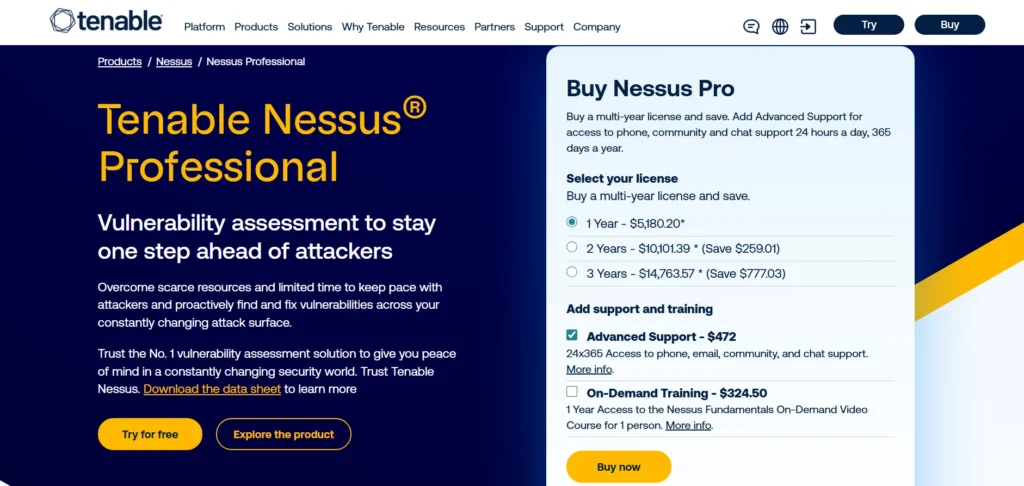
Tenable has created Nessus, which is perceived as one of the most popular and reliable vulnerability scanners in the cybersecurity sector. Nessus is known to be accurate and covers a wide range of scanning and is used in websites, servers, cloud/internet environments, operating systems, and network devices. It is founded on a constantly maintained library of more than 70,000+ plugins that scan the real-world vulnerabilities, misconfigurations, and nonconformance.
Nessus is particularly good at identifying typical web vulnerabilities that include SQL injection, XSS, outdated components, weak-SSL settings and authentication issues. It also offers industry-leading false-positive reduction, which means that security staff can use their time fixing actual problems and not investigating false alarms. It is easy to use, has preset scan templates and automatic reports, thus user-friendly yet powerful enough to be used by professionals.
Nessus fits perfectly into Tenable.io and Tenable.sc to enable organisations to perform simple vulnerability scanning to complete enterprise vulnerability management. Due to its dependability, scope and usability, Nessus remains the standard in the industry for enterprises, SMBs, auditors and security teams.
Key Features
- More than 70,000 detection plugins for vulnerabilities.
- Minimised false positives and accurate scans.
- Ready-made web application, PCI DSS, and configuration audit templates.
- Identifies malicious signals and misfortunes.
- Supports the Tenable ecosystem.
- Effective reporting and compliance services.
Pricing
- 1-Year License: $5,180.20
- 2-Year License: $10,101.39 (Save $259.01)
- 3-Year License: $14,763.57 (Save $777.03)
- Add-ons:
- Advanced Support: $472
- On-Demand Training: $324.50
3. Nmap

One of the most popular open-source security tools used in the entire world to detect the network and scan vulnerability is Nmap (Network Mapper). In spite of being popularly utilized as a port scanner and network mapper, Nmap has an extensive scripting engine ( Nmap Scripting Engine -NSE ) that allows the identification of many web vulnerabilities, misconfigurations and open services.
Security experts use Nmap to detect open ports, running services, and server technologies, as well as, detecting problems with the SSL protocol, network firewalls, and simple web security vulnerabilities. Nmap is able to identify typical web vulnerabilities, list CMS platforms, scan through the setup of the SSL/TLS, identify brute-force threats, and verify presence of outdated components with NSE. Its products are highly detailed, flexible, and can be used in both manual penetration testing and automated audits.
Nmap is also light with very high speeds, and it can perform in all kinds of environments, such as local networks, cloud environments, VPNs, and remote servers. It is still a necessary tool in the toolbox of any cybersecurity practitioner due to the flexibility, reliability, and capability to work in even complex and restrictive networks. It is not just that Nmap remains a tool that must be present in 2025 because it is either required to do reconnaissance, security testing, or network maintenance.
Key Features
- High-level port scanning and service detection.
- The Nmap Scripting Engine (NSE) is a powerful engine, which can be easily configured by the user to be used in their scripts
- Determines versions and technologies of servers.
- Configuration evaluation of SSL/TLS.
- Scanning Lightweight and fast.
- Operates compatible with networks and cloud.
Pricing:
- Small/Startup License: $7,980 per quarter
- Mid-Sized Company License: $11,980 per quarter
- Enterprise License: $13,980 per quarter
- Prices range from $7,980 to $98,980 depending on edition and license type.
4. Qualys
Qualys is the cloud-based enterprise vulnerability management platform that is trusted by Fortune 500 companies, financial institutions, and government agencies. As one of the leading Website Vulnerability Scanners, it offers extensive scanning of websites, APIs, networks, cloud infrastructure, containers, and endpoints, making it one of the most extensive SaaS security platforms.
In case of scanning websites, Qualys identifies a vast number of vulnerabilities SQL injection, XSS, command injection, vulnerabilities in the framework of the SSL, problems in authentication, and misconfigurations. Its cloud-based design also means that scanning occurs without performance impact and there is also provision of real-time dashboards, risk scoring and automated patch tracking. Qualys has also provided compliance modules of the PCI DSS, HIPAA, NIST, and ISO 27001, which are used to simplify audits by organizations.
Scalability can be considered to be one of its greatest strengths: Qualys can easily handle millions of assets in a wide geographical range. It is deeply integrated with DevSecOps pipelines, ticketing systems, as well as SIEM systems, which allows automated remediation processes. In the year 2025, Qualys will continue to be a major decision among large organizations and highly sensitive organizations due to its high accuracy, enterprise grade analytics and international image.
Key Features
- Continuous vulnerability scan on the clouds.
- High end dashboards and analytics.
- Identifies network, cloud, and web vulnerabilities.
- Compliance-ready reporting
- Scales to millions of assets
- Integrates with DevSecOps and SIEM.
Pricing: Not available
5. Acunetix
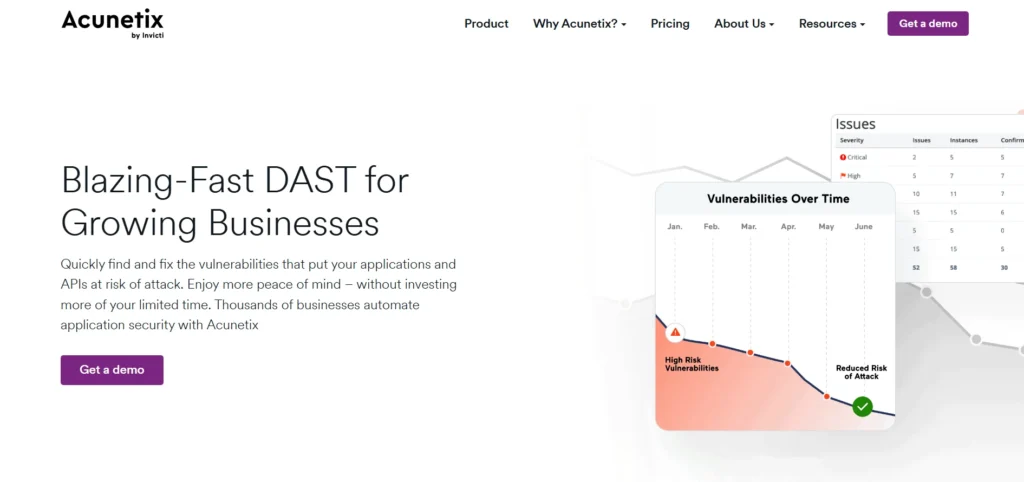
Acunetix is one of the most popular automated web application vulnerability scanners with a high level of precision, fastness, and the possibility to recognize complex vulnerabilities. It applies advanced crawling, machine learning, as well as hand-written attack payloads, to detect vulnerabilities such as SQL injection, XSS, CSRF, SSRF, authentication vulnerabilities and sensitive files that have been exposed. Acunetix is designed to be focused on the unique DeepScan engine that can analyze dynamic data, Net pages which are high on JavaScript, single page applications (SPA) and APIs with remarkable precision.
Its scanner is specialized to the current web technologies, such as HTML5, JavaScript structures (React, Angular, Vue), GraphQL and REST APIs. Acunetix is valued by security experts with its low rate of false-positive, comprehensive detail on vulnerabilities, verification of proofs of exploits, and remediation instructions that are easy to understand by developers. It works well with CI/CD software, bug management software, and security software, and is the perfect fit in DevSecOps processes.
Acunetix too has a fully automated continuous scanning platform, which allows business to keep an eye on their application security posture at all times. Applicable to companies in the service sector, agencies, and financial websites, Acunetix will be one of the best and most dependable DAST scanners in 2025.
Key Features
- Advanced deep scan engine of modern web apps.
- Identifies 7,000 even more vulnerabilities.
- Proof-of-exploit verification
- Low false positives
- JavaScript framework scanning, SPAS, and API.
- Integrates with Jenkins, Azure Devops, Jira and others.
Pricing: Custom pricing
6. Burp Suite
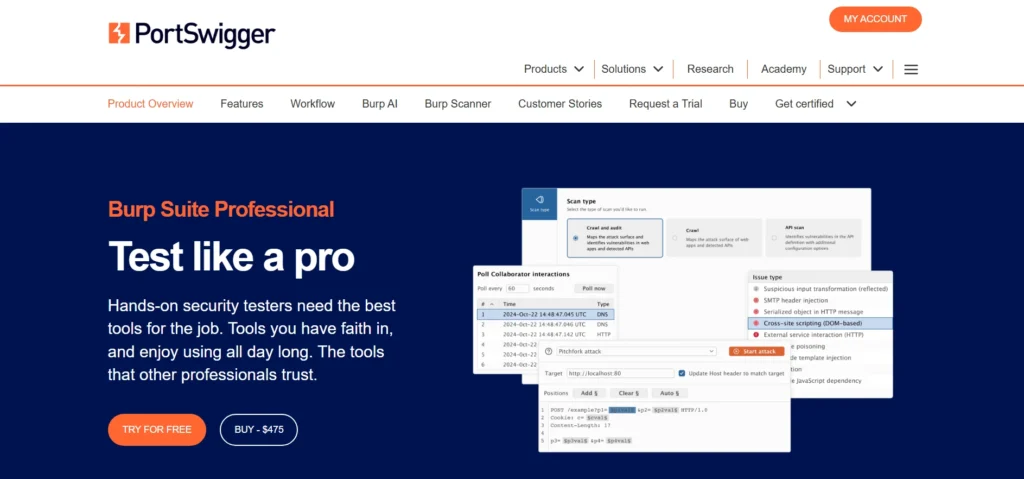
The most popular web application security tool used by the penetration testers is Burp Suite developed by PortSwinger. It integrates automated scanning with effective manual testing facilities, which makes it suitable in revealing the common vulnerabilities as well as more complex logic defects that cannot be detected through automation. The proxy-based model of Burp Suite enables a tester to intercept and modify traffic through the web using proxy servers, analyze requests, and create advanced attack payloads.
The Professional version also has a powerful DAST scanner which identifies the problems like SQLi, XSS, SSRF, IDOR, race conditions, session weaknesses and others. Meanwhile, Intruder and Repeater tools provide testers with the possibility to tailor attacks and fuzzing parameters, and verify exploitability. Burp Suite also includes a large extension marketplace (BApp Store), where SAST-like checks and automation enhancements, and analysis-specific to the framework can be found.
The ease of use, scan report, and robust community are what has made it the default tool of ethical hackers, red teams and security researchers. Burp Suite is particularly useful when the application has a dynamic nature, bespoke logic or complicated authentication process.
Key Features
- Manual scanning and automated scanning.
- Traffic interception by proxy.
- Sophisticated Intruder and Repeater software.
- Identifies sophisticated logic attacks.
- Huge extension marketplace
- The world favors penetration testers.
Pricing: Not available
7. Rapid7
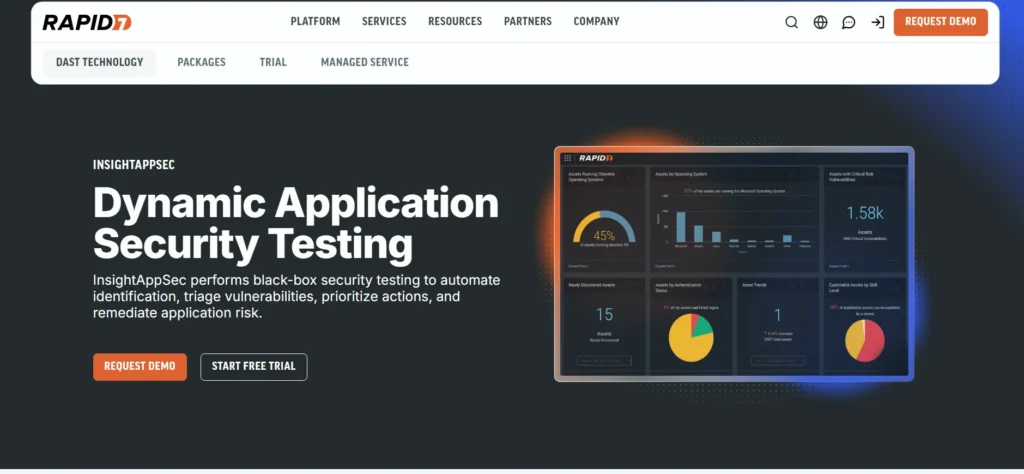
The Nexpose (Rapid7 is no longer known as InsightVM) is a powerful vulnerability detection platform applied by businesses to scan websites, servers, networks, cloud services, and IT infrastructure. As one of the reliable Website Vulnerability Scanners, it offers data-centric vulnerability intelligence in real time and is therefore very useful in high-velocity security contexts. Nexpose maintains a database of vulnerabilities that is constantly updated as per the research conducted by Rapid7 itself, contributions of the community, and actual exploit activity.
Its web scanning features detect such problems as SQL injection, XSS, obsolete components, misconfigurations, SSL vulnerabilities, and access control bugs. The difference between Nexpose and its competitors is the fact that Nexpose also has a Live Monitoring system that monitors the changes of the assets as well as the risk exposure and updates it in real-time. It is also providing risk score modeling not only on the severity but also, the exploit probability, business environment, and attack pattern.
The platform supports CI/CD systems, SIEM, cloud platforms (AWS, Azure, GCP) and ticketing (Jira and ServiceNow), all of which are successfully integrated with the platform. It streamlines vulnerability remediation processes and makes them automated. Nexpose provides scalable, enterprise wide visibility of security to large organizations.
Key Features
- Live vulnerability and threat scoring.
- Web app, network, and cloud system scans.
- Constant presence: Live Monitoring.
- Intelligent prioritization on the basis of the likelihood of exploits.
- CI/CD and SIEM integrations
- Business-level analytics and dashboards
Pricing:
- Vulnerability risk management (InsightVM): $1.93/month per asset
- Detection & response (InsightIDR): $5.89/month per asset
- Web application security (InsightAppSec): $175/month per app
- Cloud security (InsightCloudSec): $5,775/month
8. Nikto
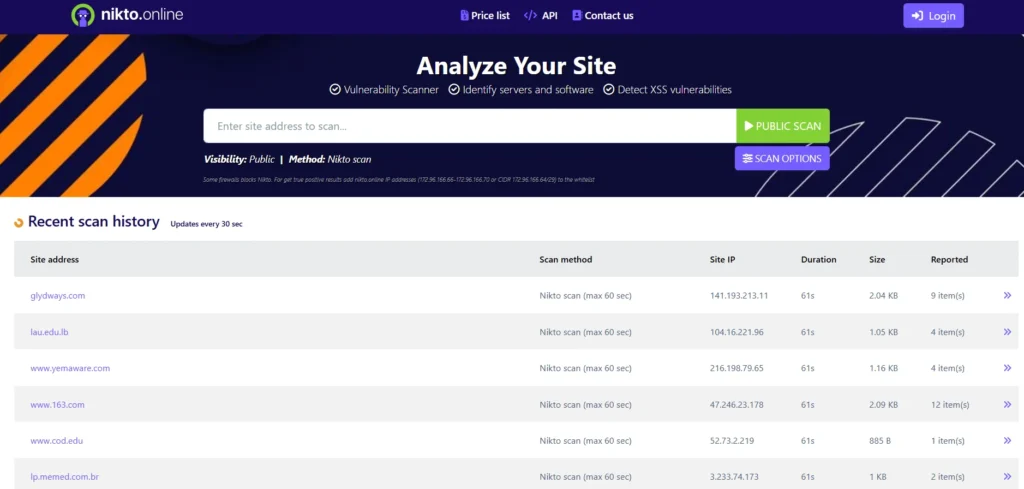
Nikto is an open source and rapid web server scanner that has been created to act as a convenient and efficient tool used by security professionals to identify common vulnerabilities. Though not as advanced as the best DAST scanners, Nikto is excellent at detecting misconfigurations, outdated software, unsafe headers, malicious files, directory traversal vulnerabilities, default setups and weaknesses related to servers.
It checks thousands of web servers against vulnerability signatures and regularly receives new vulnerability signatures. Nikto is lightweight and command line based and therefore frequently used in the reconnaissance stage of a penetration test or security audit. Although it lacks stealth scanning and in-depth JavaScript script analysis, it has an outstanding coverage of web server vulnerabilities and useful in rapid assessments.
Nikto is commonly used together with other applications such as Nmap, Burp Suite and OpenVAS in order to have a complete security test. It is quick and easy to use; therefore it is completely suitable to all IT administrators, security novices, and those who just need simple and quick answers.
Key Features
- Quick webserver vulnerability scanning.
- Identifies software that is up-to-date and malfunctions.
- Millions of tests of typical server errors.
- Constant up-to-date vulnerability database.
- Easy command-line interface
- Complementary to other scanners.
Pricing: Not available
9. Invicti
Invicti is a high-end DAST scanner that also features Proof-Based Scanning technology to automatically check on vulnerabilities with safe exploitation that are read-only and as a result of this technology, false positives are automatically removed. This renders Invicti suitable to large companies and computerized pipelines where precision is necessary.
Invicti is best at identifying SQL injection, XSS, SSRF, CSRF, authentication vulnerabilities, and other sophisticated attacks on websites, web services, and APIs and cloud applications. It has the highest level of reliability in its ability to crawl modern web applications, dynamic features, JavaScript frameworks and multi-step authentication processes.
It can fit perfectly as a part of DevSecOps processes using CI/CD extensions, API authentication, and automatic ticketing in Jira, GitHub, GitLab, and Azure DevOps. Invicti also facilitates multiple users workflow, tagging of assets, discovering attack surface, and reporting compliance. Invicti is popular with enterprises as it saves them time on manual verification, makes remediation faster, and scales to large web portfolios.
Key Features
- Evidence-Based Scanning of confirmed vulnerabilities.
- Accurate with a low amount of false positives.
- api, spa, and dynamic web application support.
- Deep CI/CD integration
- Enterprise collaboration characteristics.
- Automated discovery of attack surface.
Pricing: Not available
10. ZAP (Zed Attack Proxy)

One of the most common open-source and free Website Vulnerability Scanners is OWASP ZAP, which developers, testers, and ethical hackers rely on all over the world. ZAP is created by the OWASP community and provides a vast amount of automated and manual scanning environments, which is why it is the best choice when individuals and/or organizations need to test security at relatively low costs without sacrificing any power.
ZAP has the capabilities of passive and active scanning, intercepting proxy, fuzzing, spidering, API scanning, and brute-force testing. It facilitates automation which is scriptable and, hence, easy to incorporate into CI/CD pipelines. The tool is also effective with novices (because of its straightforward interface) as well as advanced security experts who employ its scripting engine and manual testing tools in more thorough examinations.
ZAP particularly excels in open-source scenarios, and by those developers who promote secure coding. It provides frequent community-based updates, good documentation, support of the plugins, and is a good substitute of commercial scanners in small teams.
Key Features
- Open-source and free DAST scanner.
- Intercepting proxy in manual testing.
- Passive and active scanning is automated.
- API and spidering functionality.
- CI/CD incorporation and automation that is scriptable.
- Good OWASP community support.
Pricing: free
Also read: Best Browsers with Built-in VPN
11. Wireshark
Wireshark is the most popular open-source packet analyzer and is a cornerstone of cybersecurity in the world. Although it is not a conventional vulnerability scanner, it can be essential in the analysis of network traffic, anomalies identification, and identification of potential security exposures in an ongoing state. Wireshark will enable a security expert to see the communication patterns, examine protocols, identify insecure data transmission, and debug unusual behavior by capturing packets at a granular level.
It assists in revealing the problems of unencrypted sensitive data, misformed packets, unauthorized requests, insecure protocols, incorrectly configured SSL/TLS connections, and malicious traffic indicators, such as DoS attacks and command injections. Its profound visibility makes it an indispensable resource whenever performing a penetration test, incident response, malware examination, and forensic investigations.
Wireshark can support hundreds of protocols, intuitive filtering, online capturing, and packet-per-packet view. It is also a necessity to anyone who manages network and web security due to its accuracy, flexibility and community support.
Key Features
- Live packet capturing and analysis.
- Identifies unsafe or unsecure network traffic.
- Communicated with hundreds of protocols.
- Forensics and incident response.
- Filtering and decoding on the next level.
- Full of liberty and open source.
Pricing: Not available
12. Astra Security Scanner

Astra Security Scanner is a web application vulnerability scanner of the company which develops a full-scale web-based security scanner that is aimed at companies interested in continuous and automated and human-validated security testing. It checks web pages, APIs, CMS applications, cloud applications, and third-party pictures regarding about 8,000+ recognized vulnerabilities, such as SQL injection, XSS, CSRF, misconfigured authentication, and uncovered information.
The greatest advantage of Astra is a hybrid model- the automated scanner identifies all serious vulnerabilities, which are confirmed by security experts, which has a significant impact on the false positives. It further offers continuous monitoring of the attack surface, where new URLs, subdomains, API, and shadow assets are identified immediately they are created.
Astra can be easily incorporated into the CI/CD pipelines, enabling developers to address the vulnerabilities at the beginning of the SDLC. It is easy to use with its intuitive dashboard, compliance reporting ( PCI, ISO, SOC 2 ) and real time alerts and is perfect in companies using SaaS, e-commerce websites and SMBs needing a high level of security without breaking down their systems.
Key Features
- 8,000+ automatic vulnerability tests of OWASP Top 10, SANS 25, CMS-specific weaknesses.
- Combined scanning (near-zero false positives) of automated and expert manual validation.
- Subdomain, API and new asset monitoring of the attack surfaces.
- REST, GraphQL and authenticated flow scanning API in depth.
- CI/CD aggregations with GitHub, GitLab, Bitbucket and Jenkins.
- There is report compliance (PCI DSS, SOC 2, ISO 27001, HIPAA).
- Live notifications and remediation advice to the developers.
Pricing:
- Pentest Plan: $5,999 per year for 1 target
- Pentest Plus Plan: $9,999 per year for 2 targets
- Scanner Plan: $199 per month or $1,999 per year (automated scans only)
- Enterprise Plan: $7,999 per year and up (custom for multiple targets)
13. IBM AppScan

IBM AppScan is an advanced enterprise-level application security testing package formulated to protect websites, APIs, and mobile apps. As one of the leading Website Vulnerability Scanners, it provides SAST, DAST, IAST, and mobile scanning, making it one of the most all-encompassing tools for large organizations with complex environments.
The DAST scanner of AppScan identifies such vulnerabilities as SQL injection, XSS, misconfigurations, bypasses of authentication, and sensitive data that is exposed. SAST engine examines source code to identify insecure coding practices, hard coded secrets as well as business logic problems prior to deployment. The solution is its IAST that brings real-time information when running and integrates code-level view and attack information in real time.
AppScan is a tool that fits perfectly into SDLC, providing automated scan in the CI/ CD pipeline, code repository, and development environment. Its thorough reporting, compliance capabilities, and powerful analytics have made it a favorable security solution to banks, government agencies, businesses and regulated industries.
Key Features
- AST, DAST, IAST and mobile security testing All-in-one.
- Dashboards and compliance reports that are enterprise-based.
- Detection of complex code and runtime vulnerability.
- Fits with the DevSecOps processes.
- Good analytics and risk prioritization.
- Fits well in large business settings.
Pricing: Not available
14. Detectify
Detectify is an automated web-based vulnerability scanner using the power of ethical hackers located all over the world. The main strength of it is its crowdsourced vulnerability research, new security tests are included regularly, depending on the discoveries of real hackers. This renders Detectify especially efficient in the discovery of contemporary and rising vulnerabilities and zero-day threats.
It performs scans on websites, subdomains, and APIs to identify such issues as DNS misconfigurations, SSRF, XSS, SQL injection, weak CORS configurations, and authentication defects, and sensitive data. Detectify is also a leader in managing external attack surfaces, which automatically determine shadow IT, lost subdomains, obsolete assets, and open services.
Detectify has lightweight setup, API integration, continuous monitoring, and fast scans which make it popular among SaaS companies and startups, as well as digital platforms that require swift, automated security.
Key Features
- Homeland security crowdsourced vulnerability research.
- Automated continuous web and subdomain scanning.
- Identifies new and non-known vulnerabilities.
- Peripheral attack surface management.
- Portable, web-based and easy to install.
- CI/CD and developer tools integration.
Pricing
- Surface Monitoring (up to 25 subdomains): €302 per month
- Application Scanning (1 domain): €90 per month
- API Scanning (1 API): €90 per month
15. Indusface WAS (Web Application Scanner)

Indusface WAS is a highly developed cloud-based web application scanner that identifies vulnerabilities of web sites, APIs and web servers with an excellent precision. It is an automated scanner combined with manual verification by experts and thus is one of the few hybrid scanners, which assure zero false positives. Indusface WAS has the capability of identifying a large number of vulnerabilities such as SQL injection, XSS, CSRF, privilege escalation, misconfigurations, API vulnerabilities, and business logic vulnerabilities.
Attack Surface Discovery is one of its best tools whereby the scanner is always discovering all known, unknown and shadow assets such as forgotten subdomains and abandoned URLs eliminating blind spots. It also integrates malware scanning and monitoring of defacing a website where businesses can instantly identify malicious changes being done.
AppTrana WAAP (Web Application & API Protection) is closely coupled with Indusface WAS so that it can be instantly patched to block exploitation even as the development team works on rectifying the vulnerability. This renders the platform the best option to companies that require scanning and real-time protection.
It also provides report that is compliant with PCI DSS, ISO, HIPAA, and SOC auditing compliance requirements and simple CI/CD integration with DevSecOps processes. Indusface WAS is very appropriate in the case of the enterprise, e-commerce, fintech, and high-traffic websites due to its hybrid approach and full support and monitoring.
Key Features
- Manual verification (manual verification + automation).
- None of the false positives on human-validated results.
- Continuous attack surface discovery.
- Malware and defamation surveillance.
- Automatic virtual patching through AppTrana.
- Detailed reports that are compliance ready.
Pricing: Not available
Comparison Table of Top Website Vulnerability Scanners
| Tool | Type | Key Strengths | Ideal For | Pricing (If Mentioned) |
| OpenVAS | Network + Web Scanner (Open-Source) | 50,000+ tests, credentialed scans, highly customizable, enterprise-grade without cost | Security teams needing open-source, full-control scanning | Free (Open-source) |
| Nessus | Vulnerability Scanner (Commercial) | 70,000+ plugins, very accurate, low false positives, strong compliance features | Enterprises, SMBs, auditors | 1 yr: $5,180.20; 2 yr: $10,101.39; 3 yr: $14,763.57 |
| Nmap | Network Mapper + Vulnerability Checks | Port scan, service detection, SSL analysis, NSE scripts, lightweight | Pentesters, recon, infra audits | $7,980–$98,980 (depending on license) |
| Qualys | Cloud VM + Web Scanner | Enterprise-scale, continuous scanning, strong compliance modules, real-time dashboards | Large enterprises, regulated industries | Not disclosed |
| Acunetix | DAST Web Scanner | DeepScan engine, JS/SPA/API scanning, low false positives | DevSecOps teams, enterprises with modern apps | Custom pricing |
| Burp Suite | Manual + Automated Web Testing | Intercepting proxy, Intruder/Repeater tools, detects complex logic flaws | Penetration testers, red teams | Not disclosed |
| Rapid7 (InsightVM/Nexpose) | Enterprise Vulnerability Management | Live Monitoring, risk-based scoring, wide asset coverage | Enterprises needing real-time risk visibility | InsightVM: $1.93/asset/mo; AppSec: $175/app/mo |
| Nikto | Web Server Scanner (Open-Source) | Fast detection of server misconfigurations, outdated software, unsafe headers | Quick assessments, recon, small teams | Free |
| Invicti | DAST (Enterprise) | Proof-Based Scanning (auto-verified exploits), excellent accuracy | Large companies, CI/CD automation | Not disclosed |
| OWASP ZAP | Open-Source DAST | Passive/active scanning, proxy, API scanning, strong community | Developers, small teams, open-source lovers | Free |
| Wireshark | Network Packet Analyzer | Deep traffic analysis, protocol debugging, forensics | Incident responders, network analysts | Free |
| Astra Security Scanner | Hybrid Automated + Manual | 8,000+ tests, human validation, attack surface monitoring, compliance reporting | SaaS, e-commerce, SMBs with limited security staff | Scanner: $199/mo; Pentest plans: $5,999–$9,999/yr |
| IBM AppScan | SAST + DAST + IAST | All-in-one enterprise AST, strong analytics, deep integration with SDLC | Banks, government, large regulated environments | Not disclosed |
| Detectify | DAST + Attack Surface Mgmt | Crowdsourced research, detects emerging threats, shadow asset discovery | SaaS companies, startups needing automation | Monitoring: €302/mo; App Scan: €90/mo |
| Indusface WAS | Hybrid Web Scanner + WAAP | Manual validation, zero false positives, malware/defacement protection, virtual patching | E-commerce, fintech, enterprise apps | Not disclosed |
Benefits of Website Vulnerability Scanning
1. Fast crawling without interruptions
The performance of modern scanners can crawl thousands of web pages in high speed automatically without any impact on your website performance and it is guaranteed to cover all of them without any downtime.
2. Find All The Known Vulnerabilities
Scanners reveal an extensive list of attacks such as SQL injection, XSS, CSRF, broken access control, and even DDoS attack-related vulnerabilities- with AI-based systems updating themselves immediately whenever a new vulnerability is detected, at a faster rate.
3. Detecting Business Logic defects
Advanced platforms integrate automation with human security knowledge to identify advanced business logic errors that are normally not identified by standard automated scanners.
4. Identify Problems at the SDLC
Scanners added to CI/CD pipelines will enable teams to identify and address vulnerabilities in the development phase before reaching production, and, therefore, save time, cost, and effort.
5. Whole System Discovery of Attack Surfaces
Scanners trace your overall digital footprint and subdomains, APIs, third-party integrations, and shadow assets so that there is not some unprotected weak entry point.
6. On the fly Malware and Defacement protectors
These tools are constantly watching out against malicious script injections, unauthorized content modifications and site defacements to ensure that you can respond promptly to safeguard your brand and users.
7. Security Intelligence & Analytics
Scanners give you deep analytics of attack patterns, vulnerabilities often used, and weak points- assisting you in enhancing your long-term security position.
8. Audit-Ready Reporting
You receive detailed reports with the level of severity, impacted URLs, technical information, remediation measures and compliance mapping-auditing, documentation and communication between the teams have become much easier.
Common Myths About Vulnerability Scanners
To this day, there are still businesses who are reluctant to apply vulnerability scanners due to the misconceptions.
- Myth: Scanners are only necessary in big enterprises.
As a matter of fact, small and medium businesses are easier victims since attackers believe that they are less secure.
- Myth: Scanning decelerates my site.
The current scanners operate silently in the background and do not interfere with the speed and user experience of the websites.
- Myth: Suffices: Manual testing.
As much as multifaceted problems are intercepted by the expert, integration of both hand and computer scanners offers the perfect and complete protection.
Conclusion
Making use of website vulnerability scanners is no longer an option, but rather a necessity in the current landscape where cyberattack tactics are changing daily. These tools operate in advance to identify vulnerabilities, remind you in real time and assist you in correcting problems way before they can be used against you. One tool is never sufficient.
A layered approach is the most secure: SAST will make sure that your code is clean and safe, DAST will test your site performance against real-world attacks, IAST/manual testing will be able to identify complex logic errors, and network scanning will secure your server and infrastructure.
Combined with these tools, there is a powerful, interconnected protection system. When you invest in the right combination of scanners today, you not only safeguard your data but also your brand and reputation, the trust of your customers and the future of your business because a security breach can be very expensive and hurtful.
FAQs
1. Are Vulnerability Scanners Substituting for Manual Penetration Testing?
Scanny is aiding automation, but manual testing tests the deeper logic based flaws.
2. What is the Frequency at Which I Need to Scan my Website?
Preferably on a weekly basis and most certainly following each update or deployment.
3. Is it Possible to Catch Zero-Day Vulnerabilities with the Scanners?
The majority are detected by the strategies concerning known vulnerabilities whereas the sophisticated devices employ behavior analysis to identify novel threats.
4. Are Scanners Compatible with any Websites and CMS Platforms?
WordPress, Shopify, custom-made applications, APIs, and others are all supported by modern tools.
5. Will the Vulnerability Scanners Work on a Live Site?
Reliable scanners are protocol to scan safely and do not affect performance.
