

Picture the moment your client’s primary link drops. With an LTE or 5G gateway already on-site, sales keep ringing and you look like a hero. That little box didn’t come straight from the OEM—it came from a distributor that had stock, credit terms, and engineers on call.
So which Cellular Gateway Distributors for MSPs make your life easier? We sifted partner portals, channel forums, and merger filings to build a ranked, evidence-driven short list. You’ll get 2024 market context, a quick comparison matrix, and plain-English mini-reviews, all aimed at helping you choose a partner that keeps projects moving and margins healthy.
Why Cellular Failover is Surging in 2024
Business networks face two pressures: nonstop digital projects that expect always-on links, and a risk landscape where “offline” equals lost revenue. Cellular WAN fills the gap, and the numbers prove it.
Global revenue for cellular IoT gateways is rising about 14 percent a year and is on track to reach $2.18 billion by 2026. Vendors now ship dual-SIM 5G routers, edge-compute gateways, and FirstNet-certified hardware because enterprises want resilient last-mile links that fiber alone can’t promise.
The need goes beyond backup. AI workloads crave real-time data. A recent Ericsson survey found 88 percent of European executives believe next-gen connectivity is the key to realizing AI value (TechRadar Pro). That urgency lands on MSP desks. When a branch, pop-up site, or vehicle needs low-latency bandwidth tomorrow, you don’t wait weeks for new cable; you drop in a 5G gateway and go live before lunch.
Hardware is improving just as supply chains stabilize. The chip crunch of 2022 has eased, yet lead times for some 5G modules still stretch past eight weeks. Distributors that forecast well and keep local stock pull ahead.
TD SYNNEX, for example, surfaces live inventory and lead-time data through its Digital Bridge APIs and ConnectSolv portal, so partners can secure hard-to-find 5G routers before they slip into back-order.
That visibility shifts projects from guess-and-hope timetables to confirmed cut-over dates.
Regulation adds fuel. Public-safety projects need Band 14 or full FirstNet certification, and healthcare or retail rollouts must meet HIPAA or PCI rules. New gateways include secure boot, TPM chips, and eSIM options that let you swap carriers without touching the device, features you’ll only find if your distributor stays certification-ready.
Put simply, demand for cellular failover keeps climbing because modern apps won’t wait. Distributors must stock current 5G SKUs, keep them on the shelf, and back them with experts who understand real-world rollouts. The next sections show who meets that bar.
How We Scored Every Distributor
Before any company earned a spot on our list, we ran each one through the same six-factor stress test. You deserve to see that playbook first, so you can double-check our rankings against your own priorities.
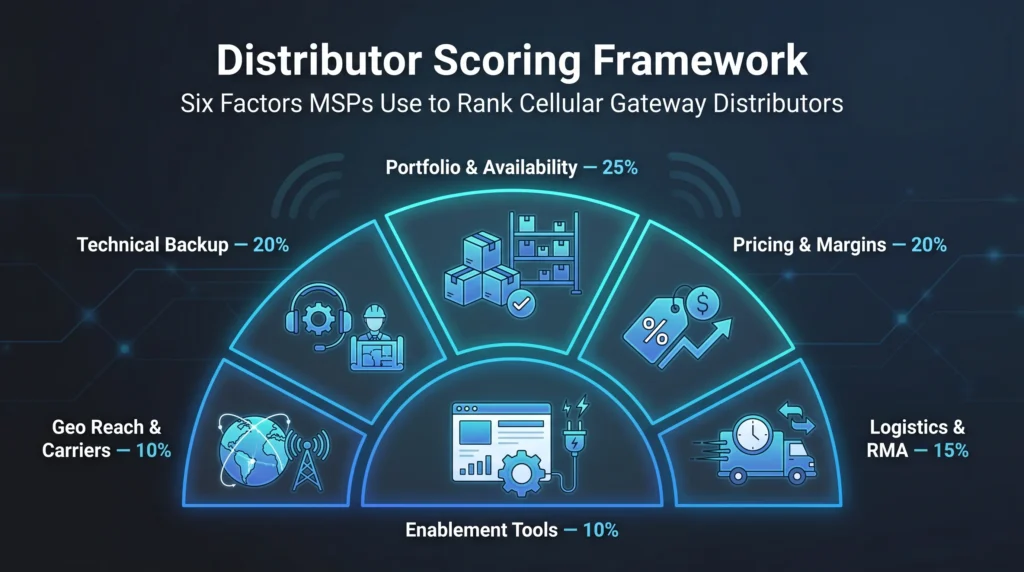
We began with portfolio and availability. Stocking the latest Cradlepoint 5G adapter is table stakes; keeping it on the shelf when the next silicon shortage hits is the real win. This factor counts for 25 percent of the score because, without hardware in a box, nothing else matters.
Next comes pricing power and margin programs at 20 percent. We looked at deal-registration rebates, extended terms for MSPs, and any “as-a-service” leasing that shifts capex to opex. Lower acquisition costs flow straight to your bottom line and help you stay sharp on monthly service bundles.
Technical backup also holds 20 percent. We asked whether a real engineer will answer when an APN refuses to authenticate at 7 pm. Distributors that provide solution architects, hands-on labs, or certification classes rose quickly.
Logistics and RMA velocity earn 15 percent. Blind drop-shipping, multi-warehouse coverage, and two-day cross-country delivery shorten project timelines and reduce client headaches.
We set aside 10 percent for partner-enablement tools: quoting portals, APIs that sync to PSA platforms, and marketing development funds. If a distributor helps you automate ordering or co-brand a pitch deck, you scale faster.
The final 10 percent measures geographic reach and carrier relationships. MSPs supporting multi-state fleets or global branches need a distributor that speaks Verizon and Telus, not just the local courier.
Add it up and you have a clean 100-point matrix that lets us rank objectively and spotlight where each contender shines. Keep this framework handy; it doubles as a checklist for vetting any distributor that didn’t make the cut.
Distributor Snapshot: at-a-glance Comparison
You asked for a quick way to spot the standouts, so we boiled our six-factor rubric into one grid. Spend sixty seconds with it and you’ll know which distributor hits the points that matter most to your next rollout.
| Rank | Distributor | Portfolio & Stock | Pricing & Margins | Tech Support | Logistics Speed | Enablement Tools | Carrier Reach |
| 1 | TD SYNNEX | ⭐⭐⭐⭐½ | ⭐⭐⭐⭐ | ⭐⭐⭐⭐ | ⭐⭐⭐⭐½ | ⭐⭐⭐⭐ | Global + US Tier-1 |
| 2 | Ingram Micro | ⭐⭐⭐⭐ | ⭐⭐⭐⭐ | ⭐⭐⭐½ | ⭐⭐⭐⭐ | ⭐⭐⭐½ | Global + US Tier-1 |
| 3 | Arrow Electronics | ⭐⭐⭐½ | ⭐⭐⭐ | ⭐⭐⭐⭐ | ⭐⭐⭐ | ⭐⭐⭐ | Global + Niche |
| 4 | D&H Distributing | ⭐⭐⭐ | ⭐⭐⭐½ | ⭐⭐⭐ | ⭐⭐⭐⭐ | ⭐⭐⭐ | US / Canada |
| 5 | Alliance (Tessco + GetWireless) | ⭐⭐⭐⭐ | ⭐⭐⭐ | ⭐⭐⭐⭐ | ⭐⭐⭐ | ⭐⭐⭐ | North America, carrier-centric |
| 6 | ScanSource + Intelisys | ⭐⭐⭐ | ⭐⭐⭐½ | ⭐⭐⭐½ | ⭐⭐⭐ | ⭐⭐⭐⭐ | US Tier-1 + agent model |
| 7 | Converge IoT | ⭐⭐⭐ | ⭐⭐⭐ | ⭐⭐⭐½ | ⭐⭐⭐ | ⭐⭐½ | US, carrier-aligned |
| 8 | Novotech | ⭐⭐⭐ | ⭐⭐½ | ⭐⭐⭐⭐ | ⭐⭐½ | ⭐⭐½ | US / Canada, industrial focus |
Stars show relative performance inside each factor, not absolute figures. A half star signals a narrow edge when two distributors are close.
Read the table left to right. If your top concern is next-day stock on Cradlepoint gear, focus on the first column and you’ll see TD SYNNEX and Ingram lead. If you live or die by antenna advice, check the tech support column where Arrow and Alliance pull ahead.
8 Best Cellular Gateway Distributors for MSPs
1. TD SYNNEX: the One-Stop Powerhouse for Connectivity
TD SYNNEX defines scale. With more than 2,500 vendor lines and warehouses on every major continent, TD SYNNEX also maps those choices into ready-made bundles on its Networking Solutions for Modern Connectivity hub, covering SD-WAN, 5G/IoT gateways, POTS line replacement, and LTE device activation, so “back-ordered” rarely enters the conversation. Its ConnectSolv practice calls itself “your one-stop technology solutions aggregator,” bundling routers, SIM activation, antennas, and managed services under one roof.
That breadth helps when a rollout changes mid-project. Need to swap a 4G router for a 5G-SA unit and add high-gain antennas? The same portal quote can include both, ship tonight, and land in two states tomorrow morning.
Pricing stays sharp. Volume rebates start at modest thresholds, and TD SYNNEX’s financing arm can turn a six-figure hardware order into predictable OpEx that fits a monthly service bundle.
Enablement sets the company apart from other broadliners. The Digital Bridge platform feeds inventory, ETA, and deal-reg data straight into Microsoft Teams or your PSA, removing manual quote work. Solution architects in the IoT and Connectivity group join calls to sanity-check RF designs before you spend labor on-site.
The trade-off: personal hand-holding is thinner than at boutique distributors. For MSPs juggling multi-vendor branches or national fleet projects, though, TD SYNNEX offers the fastest path from quote to delivered box. No plan B truck rolls required.
2. Ingram Micro: the Global Safety Net with Cloud-level Perks
Ingram Micro feels less like a distributor and more like a logistics giant that happens to move routers. Its worldwide footprint rivals TD SYNNEX, so if you manage stores in Miami today and warehouses in Mexico tomorrow, one purchase order still does the trick.
Hardware choice is broad and current. Ingram’s line card carries every mainstream cellular brand—Cradlepoint, Peplink, Sierra Wireless, and Teltonika—and layers on accessories from antennas to PoE injectors. Stock depth is solid, though hot 5G SKUs can move quickly; set up automated inventory alerts in the Xvantage portal to stay ahead.
Credit flexibility is the quiet advantage. Newer MSPs often receive better terms here than with other giants, especially when they bundle hardware with Ingram’s cloud marketplace subscriptions. Pair a router sale with SD-WAN licensing or a managed firewall add-on and you gain package rebates that pad your margin without a separate negotiation.
Support is strong, but proactive engagement depends on you. Ingram’s solution engineers tackle tough RF questions and will lab-test unusual SIM or APN combos once you raise your hand. Follow-through is quick and detailed.
If you want white-glove guidance every step of the way, check the specialists later in this list. For MSPs scaling across multiple countries, or simply seeking predictable credit, competitive pricing, and an efficient portal, Ingram Micro serves as the global safety net that keeps complex rollouts from turning into back-order travel journals.
3. Arrow Electronics: Engineering Muscle for Complex IoT Plays
Arrow’s value shows the moment a client needs more than a plug-and-play router. Picture oil-rig sensors sending MQTT over LTE or a private 5G network that must tie into legacy serial gear. Arrow’s IoT and Edge Solutions team thrives on puzzles like these and backs them with lab access, reference designs, and component-level insight you will not find at a broadline warehouse.
Inventory leans industrial: Cradlepoint, Digi, Teltonika, MultiTech, and antenna brands the big boxes skip. Need a DIN-rail power injector or a temperature-rated enclosure? Arrow stocks it. They will even pre-assemble kits so your field tech grabs one SKU and heads to site.
Pricing is fair, not rock-bottom. Arrow’s real currency is time saved on design iterations. Solution architects walk through RF propagation, certification, and carrier-lab requirements before hardware ships, so you avoid costly field rework.
Logistics are solid but less “Prime style” than TD SYNNEX or Ingram. Plan a couple extra days for specialty items or tap Arrow’s forward-stock programs, where they hold gear under your name for phased rollouts.
If your MSP model revolves around turnkey branch connectivity, Arrow may feel overbuilt. When the scope shifts from “backup internet” to “edge AI-ready gateway talking to Modbus sensors over CBRS,” though, Arrow keeps the change profitable instead of painful.
4. D&H Distributing: High-Touch Partner for the SMB-Focused MSP
D&H trades scale for service, and many smaller MSPs wouldn’t have it any other way. Open an account and you’re paired with a rep who answers on the second ring, tracks down inventory quirks, and offers credit terms that feel tailored, not templated.
The catalog covers essentials such as Cisco Meraki MG, Peplink MAX, and the new Teltonika 5G compact series, yet it avoids the endless SKUs that clog search filters. That focus keeps popular models in stock and ready to ship the same day from Pennsylvania or California, putting gear on most U.S. doorsteps within two days without air-freight charges.
Pricing sits in the sweet spot. Raw cost may be a hair above broadline giants, but D&H closes the gap with promo bundles and extended net terms for new MSPs. “Solutions Lab” webinars walk through real deployment scenarios, so you get practical tips instead of vendor slide decks.
Flexibility is the standout. Need blind drop-shipping with your logo on the packing slip? Done. Want kitted boxes that bundle a router, SIM, and antenna under one SKU? They’ll pre-label everything and feed tracking numbers straight to your PSA.
Scale is the only limitation. If you land a 2,000-site nationwide deal, D&H will lean on vendor warehouses, adding a few days. For regional or SMB rollouts, though, the mix of responsive people and efficient logistics makes you feel like their only customer, an edge that can win renewals.
5. Alliance (Tessco + GetWireless): a Wireless-Only Super-Distributor
When your deployment needs stretch beyond a simple router to antennas, enclosures, boosters, and a carrier-certification checklist, Alliance is the specialist you call. The 2023 merger that folded Tessco and GetWireless into one brand created a catalog that spans everything from CBRS small-cell radios to FirstNet-certified gateways, all under one purchasing agreement.
That consolidation saves field time. Instead of juggling three POs for router, antenna, and mounting kit, you send one to Alliance and receive a kitted box labeled by site. Warehouses stock notoriously hard-to-find SKUs such as high-gain MIMO antennas or Band 14 booster amps, so last-minute spec changes do not derail your timeline.
Technical help is a phone call away and refreshingly RF-savvy. Legacy Tessco engineers guide partners through line-of-sight math, while former GetWireless reps know which firmware build a rugged router needs to pass Verizon’s latest open-development test. That depth of wireless knowledge beats what you will find at any broadline house.
Pricing lands in the middle of the pack, but Alliance balances list cost with value-add services: site-survey tools, pre-terminated coax, and custom labeling. The only headache is that some back-end systems are still merging, so expect the occasional dual login until consolidation finishes.
If wireless reliability drives revenue in public safety fleets, industrial IoT, or outdoor venues, partnering with a distributor built around RF gear—not general IT—pays dividends in uptime and fewer truck rolls. Alliance earns its place as the most complete “everything cellular” counter in North America.
6. ScanSource + Intelisys: Marrying Hardware Margins with Recurring Connectivity Revenue
ScanSource alone is a solid networking distributor. Add Intelisys, the master agent it acquired, and you gain a twin-engine model few rivals match: box sales on one side, carrier commissions on the other. For MSPs aiming to grow monthly recurring revenue, that mix is gold.
Here is how it works. You quote a Cradlepoint branch router through ScanSource. At the same time, an Intelisys channel manager helps bundle Verizon or AT&T data plans, add a cloud firewall, and deliver a single customer-facing proposal. Hardware margin plus residual commission, all on one statement.
Operationally, ScanSource keeps logistics steady, pulling from regional hubs and offering next-day delivery on mainstream SKUs. If a product back-orders, the team suggests certified alternates and adjusts the carrier piece so your service turn-up stays on track.
Training stands out. ScanSource University mixes vendor-led courses with carrier-agnostic WAN workshops, so your sales team learns to position LTE and 5G services, not just move hardware. Coaches also guide you through quoting portals that can feel murky to first-time agents.
The trade-off: mastering the agent model takes homework. Commission cycles differ from resale cash flow, and Intelisys paperwork can feel dense until you earn your first check. Once the process is clear, the power to pitch “connectivity included” becomes a true differentiator.
For MSPs aiming at fully managed, all-inclusive WAN services and willing to learn the agent ropes, ScanSource plus Intelisys offers a direct path to higher lifetime value without adding another vendor.
7. Converge IoT: Speed Dial to the Carrier Core
Converge IoT is a scrappy specialist that works inside the carrier ecosystem, not just alongside it. The team partners closely with T-Mobile and keeps direct lines into Verizon and AT&T engineering desks, giving you faster answers on device certification, SIM activation, and rate-plan quirks than any generic help queue.
Catalog depth is narrow on purpose. You’ll find a curated lineup of 4G and 5G routers from Cradlepoint, Peplink, Inseego, and a few rising OEMs that already cleared carrier lab tests. That focus keeps inventory fresh and ready to ship, cutting firmware roll-backs and last-minute SKU swaps.
Packaging sets Converge apart. The company bundles hardware, data plans, and mobile security add-ons like Akamai SIA into a single quote, so you present one clean price to the client. Smaller MSPs also value the cash-flow assist: Converge can match hardware financing to the carrier contract term, turning large capex into a predictable monthly bill.
Support feels boutique. A sales engineer who knows RF will jump on a screen share, walk through APN settings, and stay on standby during first-site turn-up. The trade-off: if you need a brand outside their lineup, you’ll source it elsewhere, and international projects remain U.S.-centric.
Choose Converge IoT when carrier alignment and rapid certification beat sheer product variety. The company will not win a SKU-count contest, but when time to activation is the metric that matters, its tight focus becomes your competitive edge.
8. Novotech: Niche IoT Expertise for Industrial and Edge Deployments
Novotech rounds out the list as the go-to distributor when your project leaves the comfort of air-conditioned branch offices and heads into factories, vehicle fleets, or remote telemetry sites. Born in Canada and active across North America, Novotech has spent two decades immersed in M2M and industrial IoT.
The catalog proves it. You’ll find Cradlepoint and Peplink, plus Digi, Robustel, MultiTech, and satellite failover units that most broadliners never stock. Need a LoRaWAN gateway to backstop cellular? They have options on the shelf. A consultative sales team enjoys whiteboarding power budgets, antenna placement, and environmental ratings before anyone quotes a SKU.
Novotech’s blog and comparison charts, such as its side-by-side of Cradlepoint branch adapters, show the depth of testing done in-house. Ask about eSIM fallback or Cat-M1 coverage in northern Alberta and expect a data-driven answer, not a marketing gloss.
Pricing reflects boutique scale; you will pay a few points more on commodity gear. The trade-off is fast access to specialty items without minimum order headaches. Logistics is split between Canadian and U.S. warehouses; most U.S. customers receive ground shipments in three to four days, faster if you use the cross-dock service out of Buffalo.
Choose Novotech when your MSP tackles harsh-environment connectivity, edge AI sensor hubs, or fleet telematics where “it just works” must survive dust, vibration, and sub-zero mornings. The company’s industrial DNA turns what could be exotic projects into repeatable, profitable runs.
Wrapping up: Match the Right Distributor to your Growth Path
Cellular failover is no longer niche; it drives everything from AI-powered retail analytics to remote industrial control. The market is on pace to reach $2.18 billion in gateway revenue by 2026, which makes your choice of distribution ally as strategic as the hardware itself.
If your priority is breadth, automation, and global scale, TD SYNNEX or Ingram Micro will keep shelves full and your PSA synced. Need deep RF insight or specialty antennas? The Alliance–Tessco–GetWireless team was built for that. Want recurring revenue through bundled data plans? ScanSource plus Intelisys turns one router sale into years of carrier commission.
Smaller MSPs after VIP treatment can lean on D&H’s high-touch model, while those tackling rugged IoT can avoid trial-and-error by tapping Novotech’s industrial expertise. When certification timelines threaten your go-live date, Converge IoT’s direct carrier lanes step in.
Whatever path you choose, insist on three non-negotiables: current-gen 5G stock on the shelf, responsive engineers who speak APN, antenna, and portal tools that spare you spreadsheet gymnastics. Cradlepoint’s own guidance is blunt: enterprise buyers are expected to work through “our world-class global ecosystem of distributors, resellers, managed service providers, and integrators.” That’s why many businesses specifically look for Cellular Gateway Distributors for MSPs that can provide reliable support, scalable inventory, and deployment expertise. Choose wisely within that network and you’ll ship faster, protect margin, and avoid a panic the next time a backhoe finds your client’s fiber.
Ready to move? Shortlist two distributors aligned with your biggest pain point, request their partner kits, and set up a joint scoping call this week. The best time to lock in supply and support is before the next project appears, not after the outage alert hits your inbox.
