

In a world where cyber threats are taking a new twist never seen before, safeguarding sensitive information has now become the main pillar of survival in business. Data breaches incur millions of dollars in damages, mistrust, and fines. In 2026, advanced threats such as AI-based attacks, ransomware variants, and zero-day exploits will become a reality and can not be contained by conventional security controls.
Organizations require the most advanced data security software that integrates artificial intelligence, real-time threat identification, and network protection, both in the cloud and on-premises and hybrid environments. This guide discusses the 10 best data security tools that are transforming the manner in which businesses secure their most important asset, data, and remain in sync with the strictest regulations, such as GDPR, HIPAA, and PCI DSS. These solutions are the future of cybersecurity in 2026.
What Are Data Security Tools?
Data security tools are software applications designed to protect sensitive information from unauthorized access, compromise, or cyberattacks. These tools have several layers of protection, such as encryption, access controls, threat detection, and compliance monitoring, to protect data throughout its lifecycle, including creation and storage through transmission and deletion.
The current data protection solutions use artificial intelligence and machine learning to detect anomalous activities, forecast possible vulnerabilities, and automatically react to threats on the fly. They offer end-to-end coverage of databases and files, cloud storage, and network infrastructure, and assist companies with meeting regulatory demands and ensuring customer confidence in a more perilous cyber environment.
Key Features to Look for in Data Security Tools
- Threat detection and automatic response: features where threats are detected and countermeasures implemented without causing harm.
- Multi-layered encryption: in the case of both data at rest and data in transit, data is safe in all settings.
- Compliance and audit reporting: functionality that simplifies compliance with such laws as GDPR, HIPAA, and SOC 2.
- AI-powered behavioral analytics that identify the abnormality in the patterns and zero-day threats that signature-based tools may fail to identify.
- Centralized management dashboard: offering a single view and control of the cloud, on-premises, and hybrid infrastructures.
- Integration features: using current security stacks without disrupting business operations during deployment.
Benefits of Using Data Security Tools
- Avoids financial losses: by preventing breaches of information that might cost millions in damages, fines, and remedial costs.
- Ensures compliance with regulations: automatically, it will lighten the audit load, and means not paying expensive penalties to non-compliance.
- Safeguards brand reputation: by averting data leakages that undermine customer confidence and competitive edge.
- Facilitates safe digital transformation: it provides organizations the opportunity to use cloud and new technologies without sacrificing their security.
- Minimizes operational overhead: by automation, manual security operations and alert fatigue are eliminated.
- Offers forensic support: to speedily react to incidents and analyze them closely in case of breaches.
Comparison Table of Top Data Security Tools
| Name | Key Features | Best For | Free/Paid |
| CrowdStrike Falcon | AI threat detection, Lightweight agent, Cloud-native, Ransomware protection | Enterprise endpoint protection | Paid – $59.99-$184.99/device/year |
| IBM Guardium | Database activity monitoring, Compliance automation, Real-time alerts, Vulnerability assessment | Database security compliance | Paid – Custom pricing |
| Yubico YubiKey | Hardware authentication, Phishing-resistant MFA, FIDO2 support, Multi-protocol | Account takeover prevention | Paid – $25-$95 per key |
| Bitdefender Total Security | Multi-layer ransomware protection, Secure VPN, Parental controls, Password manager | Small teams multi-device protection | Paid – $39.98-$159.99/year |
| Palo Alto Prisma Cloud | Code-to-cloud security, CNAPP platform, AI-powered prioritization, Multi-cloud support | Cloud-native application security | Paid – Credit-based from $9,000/100 credits |
| SentinelOne Singularity Cloud | Agentless scanning, Verified Exploit Paths, Container security, Offensive engine | Cloud workload protection | Paid – $30,000-$110,000/year |
| Splunk Enterprise Security | Advanced SIEM, Machine learning, Threat intelligence, Investigation workflows | Enterprise security analytics | Paid – Custom pricing |
| Forcepoint Data Security | AI mesh automation, DLP across platforms, Data classification, Policy enforcement | Cross-platform data loss prevention | Paid – Custom pricing |
| Microsoft Purview | Sensitivity labels, Office integration, Compliance center, Insider risk management | Microsoft 365 organizations | Paid – Included in E5/Custom |
| Varonis Data Security Platform | DSPM capabilities, Access analytics, Data classification, Cross-platform monitoring | Data access governance | Paid – Custom pricing |
List of Top 10 Data Security Tools for 2026
1. CrowdStrike Falcon
CrowdStrike Falcon is among the finest endpoint protection platforms in which it uses a revolutionary lightweight agent that can be deployed in minutes and requires very few system resources. Its behavioral analytics engine is an A.I.-driven system that keeps an eye on endpoint behavior to identify and prevent ransomware, malware, and advanced attacks before they can take place.
The cloud native architecture completely removes the on-premises infrastructure, and offers real time threat intelligence of millions of endpoints worldwide. The successful history of CrowdStrike consists of preventing some of the most threatening actors in the world, and it is the vendor of choice for organizations that need a serious approach to endpoint security.
Key Features:
- AI-powered threat detection
- Next-generation antivirus
- 24/7 managed threat hunting
- Cloud-native architecture
Best For: Enterprise endpoint and server protection
Pricing:
- Falcon Go: $59.99/device/year (up to 100 devices)
- Falcon Pro: $99.99/device/year
- Falcon Enterprise: $184.99/device/year
- Falcon Complete: Custom pricing
- 15-day free trial available
- 30-day money-back guarantee
Website: https://www.crowdstrike.com
2. IBM Guardium
IBM Guardium has become a standard in the industry in terms of database security and compliance. It is an all-inclusive platform that tracks all the interactions of databases in real-time, generating detailed audit trails, which meet the most demanding regulatory standards, such as GDPR, HIPAA, PCI DSS, and SOC 2. Its superior analytics service recognizes suspicious access patterns, unauthorized queries and possible data exfiltration requests before they lead to breaches.
The automated compliance reporting threat notification of Guardium frees security personnel of much of the burden even as it offers executive management of a clear impression of the database security posture of the entire data estate.
Key Features:
- Real-time database monitoring
- Automated compliance reporting
- Vulnerability assessment scanning
- Data encryption management
Best For: Database security and compliance
Pricing:
- Custom enterprise pricing
- Typically $50,000+ annually for 3 databases
- Pricing based on databases/servers protected
- No free tier available
- Demo available upon request
Website: https://www.ibm.com/products/guardium-data-protection
3. Yubico YubiKey
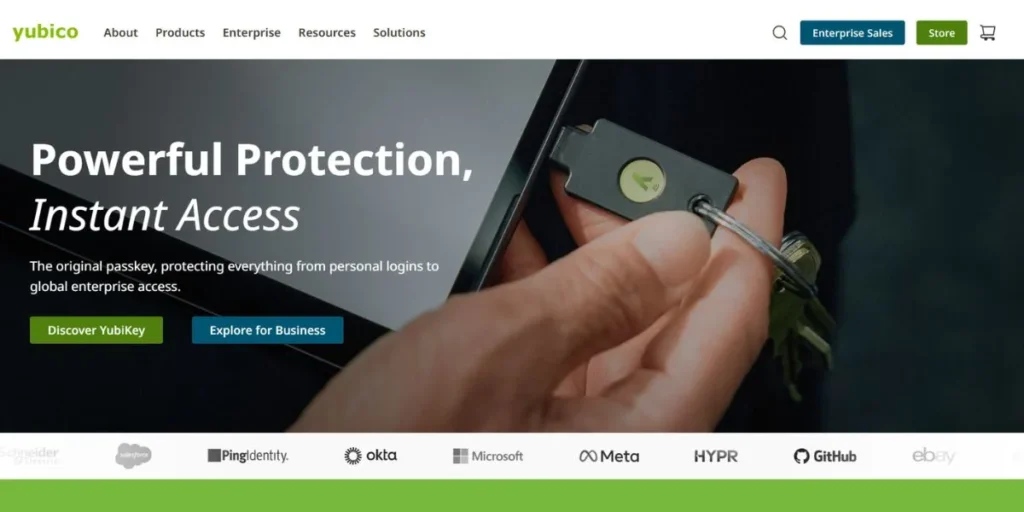
YubiKey is one of the top data security tools in cyber security, offering phishing-resistant multi-factor authentication through hardware-based protection that cannot be undermined by remote attacks. The actual presence of the user is necessary to authenticate this physical security key, which eliminates the weaknesses of SMS codes, authenticator applications, and other software-based MFA systems.
Google, Microsoft, and Facebook are among the major technology firms that use YubiKeys to secure their employees against credential theft. With its waterproof, crush-resistant, and battery-free design, the device ensures long-term durability and reliable protection, supporting more than 1,000 popular applications and services across all major platforms.
Key Features:
- Phishing-resistant hardware authentication
- FIDO2/WebAuthn support
- Multi-protocol compatibility
- No batteries required
Best For: Preventing account takeover attacks
Pricing:
- Security Key Series: $25-$30
- YubiKey 5 Series: $45-$55
- YubiKey 5C NFC: $55
- YubiKey Bio Series: $80-$95
- YubiKey FIPS Series: $95
- Enterprise volume discounts available
Website: https://www.yubico.com
4. Bitdefender Total Security
Bitdefender Total Security is one of the most reliable data security tools in cybersecurity, offering award-winning protection designed for small teams that need enterprise-level security without enterprise complexity. Its multi-layered ransomware defense uses behavioral analysis to detect and block file encryption attempts, while the included secure VPN ensures privacy on public networks.
The solution has minimal impact on system performance, allowing users to work without interruptions, and centralized management through Bitdefender Central simplifies deployment across Windows, macOS, Android, and iOS platforms. Bitdefender consistently ranks at the top in independent testing labs for malware detection rates and overall performance effectiveness.
Key Features:
- Multi-layer ransomware protection
- Secure VPN (200MB/day)
- Advanced parental controls
- Password manager included
Best For: Small business multi-device protection
Pricing:
- Total Security: $39.98/year (5 devices) – First year
- Renewal: $89.99/year
- Premium Security: $59.99/year (10 devices)
- 30-day money-back guarantee
- Free version available for basic protection
Website: https://www.bitdefender.com
5. Palo Alto Networks Prisma Cloud
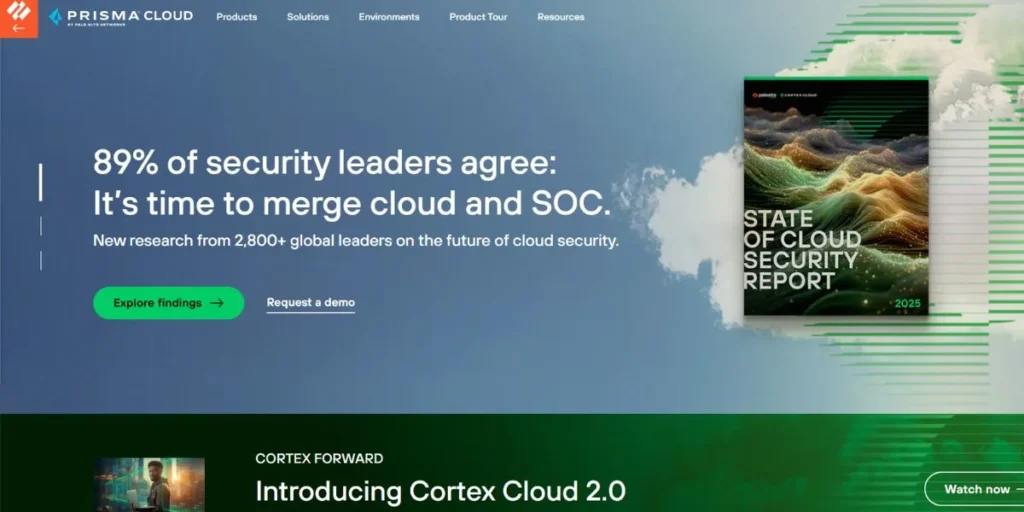
Palo Alto Networks Prisma Cloud is the best Cloud-Native Application Protection Platform (CNAPP), which protects applications across every stage of development, including code creation, up to production. Its code-to-cloud unique technique identifies vulnerabilities in infrastructure-as-code, container images, and cloud configurations before deployment and protects workloads in production.
Precision AI engine is looking at over 1 trillion events each day with automatic prioritization of risks that are most important to the company and alert fatigue has been reduced by up to 90%. Companies with more than one cloud provider have the unified protection of Prisma Cloud on AWS, Azure, Google Cloud and Oracle Cloud.
Key Features:
- Code-to-cloud security coverage
- AI-powered risk prioritization
- Multi-cloud compliance management
- Container and serverless protection
Best For: Cloud-native application security
Pricing:
- Credit-based licensing model
- Business Edition: $9,000 for 100 credits annually
- Enterprise Edition: Custom pricing
- 30-day free trial available
- Pricing based on protected resources
Website: https://www.paloaltonetworks.com/prisma/cloud
6. SentinelOne Singularity Cloud
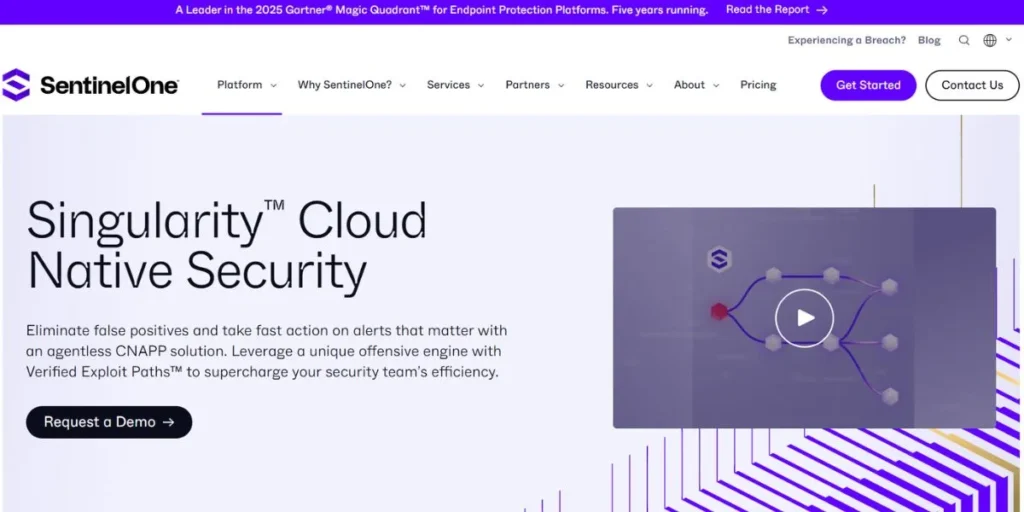
SentinelOne Singularity Cloud stands out among modern top data security tools by delivering unified cloud protection through an agentless architecture that provides end-to-end visibility without impacting performance. The platform’s Offensive Security Engine simulates real-world attack scenarios to identify Verified Exploit Paths—the exact chain of vulnerabilities an attacker could link together to breach your environment.
This evidence-based approach eliminates false positives and allows security teams to focus on genuine threats. It secures VMs, containers, serverless functions, and Kubernetes environments, using autonomous AI to detect and respond to threats in real time at machine speed.
Key Features:
- Agentless vulnerability scanning
- Verified Exploit Paths
- Container runtime protection
- Multi-cloud support
Best For: Cloud workload and container security
Pricing:
- Based on protected workloads
- Annual contracts from $30,000-$110,000
- Calculated by VMs, containers, serverless
- Custom enterprise pricing
- Demo available upon request
Website: https://www.sentinelone.com/platform/singularity-cloud-native-security
7. Splunk Enterprise Security
Splunk Enterprise Security is the best Security Information and Event Management (SIEM) solution in businesses that have enormous amounts of data and threat environments that are difficult to manage. Its modern analytics engine takes in and correlates information across hundreds of sources, such as firewalls, endpoints, cloud services, and applications to bring up concealed attack patterns that are undetected with less sophisticated instruments.
Artificial intelligence algorithms are constantly learning about your surroundings and minimizing false positives by maximizing true threats. Security analysts enjoy ready-made investigation procedures, threat intelligence integrations, and personalized dashboards that transform raw security information into actionable intelligence to respond swiftly to incidents.
Key Features:
- Advanced SIEM capabilities
- Machine learning analytics
- Threat intelligence integration
- Customizable investigation workflows
Best For: Enterprise security analytics and monitoring
Pricing:
- Custom enterprise pricing
Website: https://www.splunk.com/en_us/products/enterprise-security.html
8. Forcepoint Data Security
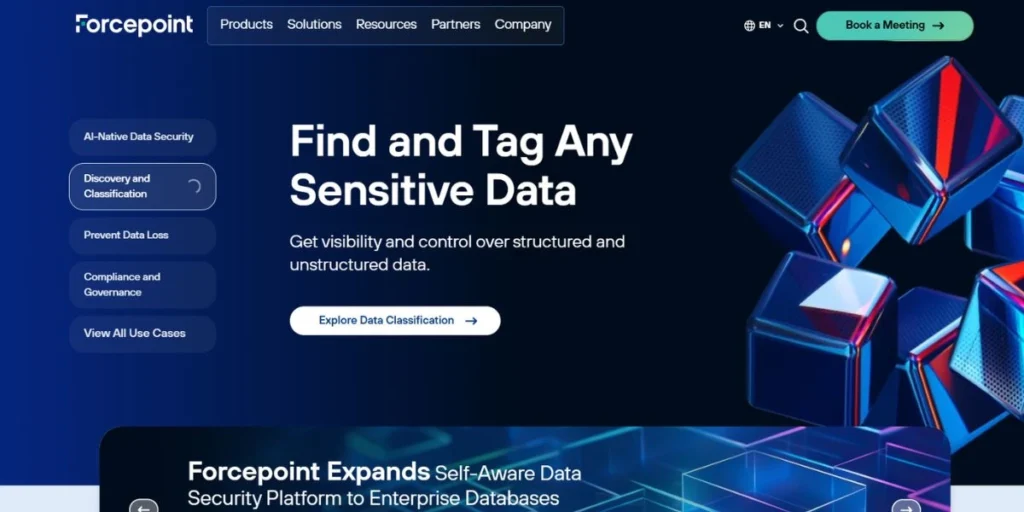
Forcepoint Data Security is widely recognized among leading data security tools in cyber security, designed to prevent data leakage across web, cloud, and private applications through its innovative AI Mesh architecture. This intelligent system automatically discovers and classifies sensitive data across your entire digital environment, applying granular policies to prevent unauthorized sharing without disrupting productivity.
By understanding user context, the platform can distinguish between legitimate business activities and high-risk behavior, reducing false positives and user frustration. It provides comprehensive coverage across email, web browsers, cloud storage, SaaS applications, and endpoints, protecting data whether it is being copied, uploaded, emailed, or printed.
Key Features:
- AI-powered data classification
- Cross-platform DLP
- Automated policy enforcement
- Contextual analysis
Best For: Cross-platform data loss prevention
Pricing:
- Custom enterprise pricing
Website: https://www.forcepoint.com/
9. Microsoft Purview
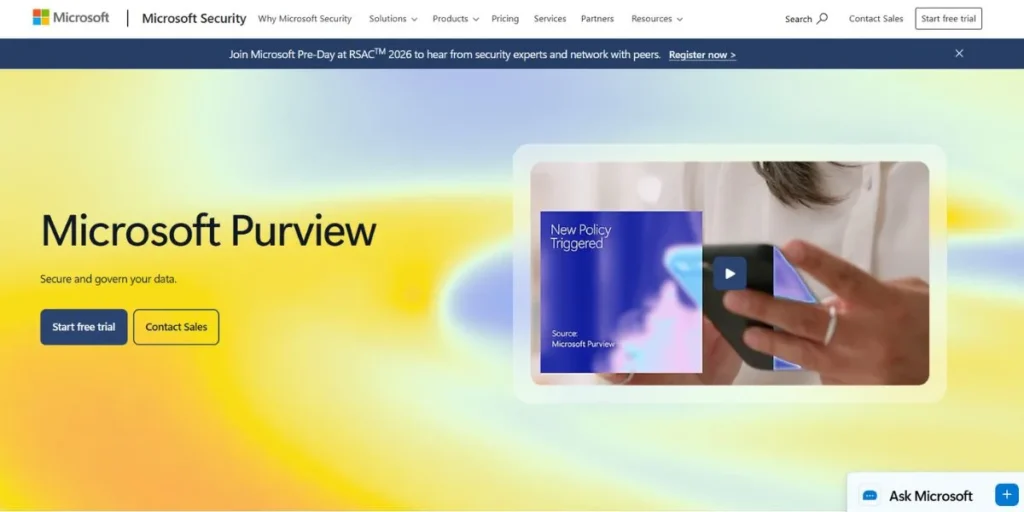
Microsoft Purview (previously known as Microsoft 365 Compliance) offers in-built data security, which is explicitly aimed at organisations with an interest in the Microsoft ecosystem. Its close connection with Office applications enables one to set sensitivity tags within Word, Excel, PowerPoint and Outlook and automatically encrypts documents and shares access rights.
The compliance center gives a single view of both Microsoft 365, Azure, and on-premises data as well as strong eDiscovery, insider risk management, and information governance tools. Those who are already using Microsoft 365 enjoy the benefit of easy and smooth deployment without extra agents or infrastructure and artificial intelligence-driven ideas of how to better data protection posture.
Key Features:
- Sensitivity labels and encryption
- Office 365 integration
- Insider risk management
- Automated compliance policies
Best For: Microsoft 365 data protection
Pricing:
- Custom enterprise pricing
Website: https://www.microsoft.com/
10. Varonis Data Security Platform
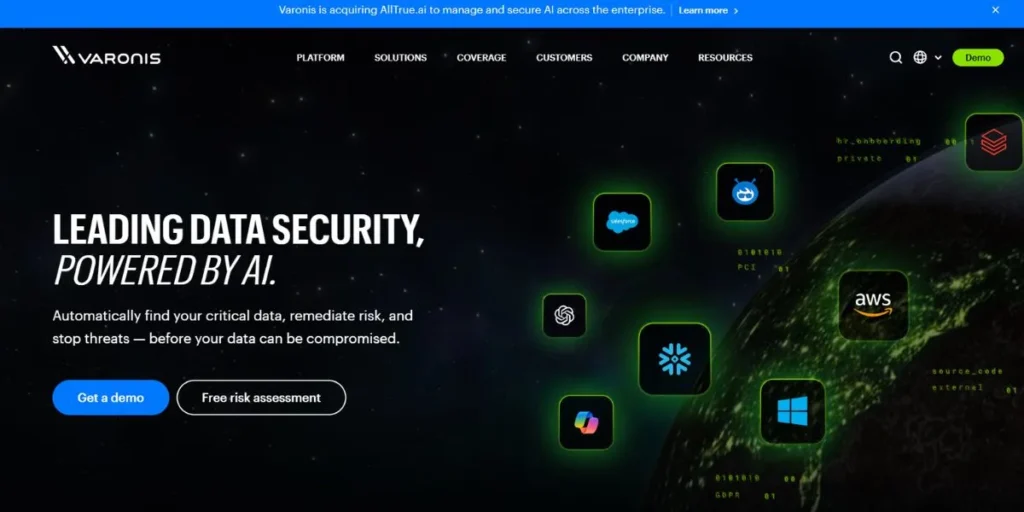
Varonis Data Security Posture Management (DSPM) is one of the most advanced data security tools in cyber security, delivering deep visibility into who is accessing what data across platforms such as Salesforce, Google Drive, SharePoint, and file servers. The platform automatically maps data relationships, identifies over-permissioned users, detects stale data, and highlights sensitive information exposed to excessive access.
Its behavioral analytics engine flags unusual access patterns—such as mass downloads or abnormal file activity—that may indicate insider threats or compromised accounts. With automated remediation capabilities, Varonis helps organizations right-size permissions, reduce their data attack surface, and enforce least-privilege access without relying on manual, case-by-case adjustments.
Key Features:
- Data Security Posture Management
- Access analytics and mapping
- Automated data classification
- Cross-platform visibility
Best For: Data access governance and DSPM
Pricing:
- Custom enterprise pricing
Website: https://www.varonis.com
How to Choose the Right Data Security Tool
- Evaluate your own security requirements: identify your most valued assets, regulatory requirements and vulnerabilities to choose the tools.
- Take scalability and integration into account: to be able to make the solution expand as your organization expands and to integrate well with your existing technology stack.
- Check reputation and support of vendors: by independent analysis and recommendations of analysts, and by references of similar organizations in your business.
- Focus on the user experience and adoption: since the best tool is useless when it is too difficult to use in your team.
- Determine the total cost of ownership: licensing, implementation, training and operating costs (not amortization of initial purchase price).
- Request trials and proof-of-concepts: the aim of this is to test the tools in your real environment, before committing serious financial resources.
Common Challenges in Data Security Implementation
- Lack of budget, and justification of ROI: complicates the ability to get executive buy-in to spend on comprehensive data security tools.
- Pain of integration: old systems and the current security infrastructure are complex and demand a high level of technical skills and time.
- False positives and alert fatigue: bombarding the security teams with irrelevant notifications that do not concentrate on real threats.
- Lack of skills and talent: in the field of cybersecurity where it is difficult to recruit qualified workers to operate complex equipment.
- Balancing between usability and security: since excessively restrictive controls are frustrating to users and decreasing productivity, developing shadow IT.
- Staying current with the changing threats: attackers are more likely to innovate their methods quicker than the organization can adjust to them.
Conclusion
The first requirement of the data security environment in 2026 is high-quality, AI-based data protection software capable of withstanding more advanced cyberattacks. The ten data security tools mentioned in this guide are the cutting edge of security, each in its area of endpoint security to cloud-native application, database monitoring to access governance. Organizations should understand that data security is not a single purchase rather it is a continuous investment that needs the appropriate amount of technology, processes and people to work together.
These tools underpin a healthy security posture whether you are a small enterprise safeguarding the personal data of your customers or an international company operating on the petabytes of sensitive information. With a well-considered analysis of the requirements, choice of suitable solutions, and a highly alert system, you could save your most precious resource of an organization, its data, and facilitate safe digitalization and keep stakeholders convinced in you in a more threatening cyber environment.
FAQs
What is the distinction between data security and cybersecurity tools?
These tools are designed expressly to safeguard data resources with the help of encryption, access controls, and monitoring, whereas cybersecurity tools are also wider in terms of network and infrastructure protection such as firewalls and intrusion detection systems.
Do small businesses have sufficient resources to purchase enterprise-grade tools?
There are indeed numerous vendors selling tiered pricing where entry-level plans cost less than $50 per device per year such as Bitdefender Total Security and CrowdStrike Falcon Go, which makes enterprise security affordable to small businesses.
How frequently are data security tools updated?
Nearly all current data protection systems are automatically and continuously upgraded with cloud-based systems and threat intelligence is automatically updated in real time and software is updated on a quarterly or on-demand basis in case of critical vulnerabilities.
Am I required to have several data protection solutions or a single solution?
A stratified solution with 3-5 tools focused on various domains (endpoint, database, cloud, identity) is typical in organizations, instead of using one tool that is not effective at all.
Which compliance regulations are these data security tools helpful in?
They help in fulfilling some of the biggest regulations such as GDPR, HIPAA, PCI DSS, SOC 2, CCPA, and industry-specific frameworks, as well as automated reporting and audit trails, which make it easy to validate compliance and lessen manual workload.